One more problematic presentation of the gospel I want to mention that occurred to me writing those recent posts is a particular manifestation of a manipulation of people when the "gospel" is preached: "You don't want to go to hell do you?" In the end, some evangelists will lean upon an appeal to fear, specifically the fear of going to hell. In the end, they communicate that the gospel is the power of God to save you from hell. That's the "salvation" part of the gospel, is that it gets you out of hell. However, scaring people into coming forward and repeating a prayer doesn't mean they are actually responding in repentance and faith. It just means ... well ... you scared them!
What does the gospel save us from? R. C. Sproul's book Saved From What? explains that the gospel saves us from the wrath of God being poured out upon us (1 Thess 1:10). That is basically a description of hell. But my concern is not that this is incorrect, but it can be like "reverse carrot stick" evangelism. Rather than attracting people to Christianity with things other than the glorious Jesus Himself, we scare people away from the alternative (by the way, I'm not suggesting Sproul did this in his book). While it is totally true that we are are saved from God's wrath, I don't believe that's the best motivation for coming to Christ, nor should it be the only motivation. We are saved "from God," that is, from God's wrath, but we are saved "for God," that is, to bring glory to God in our lives.
I still hold that the attraction should be Jesus Himself, honoring His life, death, and resurrection; that scaring people into a decision isn't a full gospel presentation; that we need to focus more on the content of the gospel and not just the responses to it (though those need to be defined carefully and correctly).
Tuesday, August 20, 2013
Monday, August 19, 2013
Confusing the Response with the Actual Gospel
An evangelist came to a church I was attending several years ago. He came preaching a message on Christian living. It was an okay sermon, very energetic. About 95% of it was directed toward those who were already Christians and how to live as a Christian. Then, right near then end, he "appended" an appeal to get saved. Said that without Christ we are lost and will never be able to have a relationship with God. Then he said that if they wanted to have a relationship with God they needed to "repeat this simple prayer." He had everyone close their eyes and those who wanted to become a Christian were to repeat his words in their heart and really mean it. Then he proclaimed that those who prayed that prayer were saved. What's wrong with this? Here is a non-exhaustive list:
1) He actually never mentioned faith/believing.
2) He quickly referenced "repent from your sins" during the prayer, with no definition or explanation given for what repentance was.
3) He was compelling people to respond ... but what were they supposedly responding to? The gospel? No, the appeal to be in a relationship with God. But what did that mean? He didn't say!
Many preachers confused the appropriate response to the gospel with the gospel itself. Repentance and faith are the appropriate responses to hearing the proclamation of the gospel. However, they are not the gospel itself. Note what Jesus says in Mark 1:15 (HCSB): "The time is fulfilled, and the kingdom of God has come near. Repent and believe in the good news!" The saving response to the good news (the gospel) is repentance and belief. But if we are repenting and believing in the gospel, then they are not the gospel itself. They are the responses not the content. So the problem with this presentation of the gospel is that it confuses the appropriate responses with the actual content of the gospel. Therefore, when repentance and faith are presented as if they are the content, the gospel has not actually been presented. So what is the person who responds by prayer a pray actually responding to? They are responding to the general concept of becoming a Christian, but that is not a response of faith, it's a response to belong to a group, to be a part of a religion or an organization. This is a huge problem today. What is the content of the gospel?
Greg Gilbert (What is the Gospel?) and Trevin Wax (Counterfeit Gospels) do a great job simply explaining this, though in different ways (both books were mentioned in a previous post). Gilbert uses four words to summarize the gospel: God, Man, Christ, Response. Each word has several concepts connected to it (these are my summaries, not Gilbert's).
God - He is creator there we are accountable to Him
Man - Adam rebelled against his Creator and transgressed God's law. Therefore he was separated from God and all his descendants, which is all of humanity, are separated from God. All people are born enemies of God. We are in a desperate situation, declared guilty before God.
Christ - God initiated a relationship with mankind over and over again: the Abrahamic covenant and the Mosaic covenant are two examples of God initiating a relationship to mankind. But His ultimate initiation was sending His Son, Jesus Christ, the God-man, to live a perfect life and die a perfect death. His sacrifice was for us. He died in our place. God himself paid the penalty that we could never pay in order to restore us in to a relationship with God. Christ's victory over death and sin, that He was who He said He was, was ultimately demonstrated by the resurrection.
Response - Now repentance (turning from sin) and faith (trusting in Christ Himself and His work on the cross as sufficient to pay for our sins) can be explained in a context as a response to the gospel.
Trevin Wax organizes it differently. He pictures the gospel as a stool with three legs. The first leg is the gospel story: creation, fall, redemption, and restoration. The second leg is the gospel announcement, which is very similar to the "God, Man, Christ, Response" explanation above. The third leg is the gospel community. He says "the gospel story is the context in which we make the gospel announcement" (Wax, 154). Without the gospel story, the gospel announcement can easily be understood, especially in a culture that is unfamiliar with the Bible. Then he says: "The gospel story and the gospel announcement lead to the formation of the gospel community" (Wax, 155). Here Wax explains that once someone has heard the gospel story and announcement, if the presentation of the gospel ends there, they might misunderstand that being incorporated into a local church body is not just an option but is essential. The church is birthed by the gospel and is the place where we are sanctified. The body of Christ is one of the tools that God uses to make us more like Christ (to sanctify us). American individualism gets in the way of this tool.
Is this more complicated then just saying: repent and believe! Yes, it is. Does it take more time? Yes, it does. Sometimes it might take several meetings for the unbeliever to understand. Sometimes they won't understand the first, or second, or tenth time you explain it. Make sure you do the true work of an evangelist and give the content to the gospel, not just the proper response when witnessing to unbelievers.
1) He actually never mentioned faith/believing.
2) He quickly referenced "repent from your sins" during the prayer, with no definition or explanation given for what repentance was.
3) He was compelling people to respond ... but what were they supposedly responding to? The gospel? No, the appeal to be in a relationship with God. But what did that mean? He didn't say!
![]() |
| Is this the content or the response? |
Greg Gilbert (What is the Gospel?) and Trevin Wax (Counterfeit Gospels) do a great job simply explaining this, though in different ways (both books were mentioned in a previous post). Gilbert uses four words to summarize the gospel: God, Man, Christ, Response. Each word has several concepts connected to it (these are my summaries, not Gilbert's).
God - He is creator there we are accountable to Him
Man - Adam rebelled against his Creator and transgressed God's law. Therefore he was separated from God and all his descendants, which is all of humanity, are separated from God. All people are born enemies of God. We are in a desperate situation, declared guilty before God.
Christ - God initiated a relationship with mankind over and over again: the Abrahamic covenant and the Mosaic covenant are two examples of God initiating a relationship to mankind. But His ultimate initiation was sending His Son, Jesus Christ, the God-man, to live a perfect life and die a perfect death. His sacrifice was for us. He died in our place. God himself paid the penalty that we could never pay in order to restore us in to a relationship with God. Christ's victory over death and sin, that He was who He said He was, was ultimately demonstrated by the resurrection.Response - Now repentance (turning from sin) and faith (trusting in Christ Himself and His work on the cross as sufficient to pay for our sins) can be explained in a context as a response to the gospel.
Trevin Wax organizes it differently. He pictures the gospel as a stool with three legs. The first leg is the gospel story: creation, fall, redemption, and restoration. The second leg is the gospel announcement, which is very similar to the "God, Man, Christ, Response" explanation above. The third leg is the gospel community. He says "the gospel story is the context in which we make the gospel announcement" (Wax, 154). Without the gospel story, the gospel announcement can easily be understood, especially in a culture that is unfamiliar with the Bible. Then he says: "The gospel story and the gospel announcement lead to the formation of the gospel community" (Wax, 155). Here Wax explains that once someone has heard the gospel story and announcement, if the presentation of the gospel ends there, they might misunderstand that being incorporated into a local church body is not just an option but is essential. The church is birthed by the gospel and is the place where we are sanctified. The body of Christ is one of the tools that God uses to make us more like Christ (to sanctify us). American individualism gets in the way of this tool.
Is this more complicated then just saying: repent and believe! Yes, it is. Does it take more time? Yes, it does. Sometimes it might take several meetings for the unbeliever to understand. Sometimes they won't understand the first, or second, or tenth time you explain it. Make sure you do the true work of an evangelist and give the content to the gospel, not just the proper response when witnessing to unbelievers.
Saturday, August 17, 2013
Robert C. McQuilkin
Robert C. McQuilkin (died 1952) preached a sermon called "Surrender and Faith." Here are two quotes that I particularly appreciated:“But I want to remind you that saving faith is not just saying is not just saying with your lips that you believe that Christ is the Son of God. The devil, the demons, believe that and they tremble and they’re waiting they’re judgment. Well they know that Jesus Christ is the Son of God. There is a believing even in the works of Christ that is not saving faith.”
“Saving faith is committing myself to the Lord. And when I
say I believe in Christ as my Savior, I wish you young people would get this,
you are taking Christ as your Lord. If you think you took Christ as your Savior
and did not take Him as your Lord then you never were saved. Because, Jesus the
Savior is Lord.”
Friday, August 16, 2013
Columbia International University
Many of you know that I have moved to Columbia, South Carolina to begin teaching in the Seminary and School of Ministry at Columbia International University. CIU has an orientation process for their new faculty that I've already appreciated greatly. It really helps new faculty (especially those who were never students here) to grasp well the ethos of the school and its history.
CIU has a broad evangelical statement of faith. This is in contrast to a denominational college or seminary that might be Presbyterian, Baptist, or Methodist. The only unique aspect to the statement of faith (or, doctrinal statement) that is more narrow than a broad evangelical stance is the statement on premillennialism.
CIU purpose statement is to "educate people from a biblical worldview to impact the nations with the message of Christ." We have five core values:
1) The authority of Scripture - Scripture governs everything CIU is about. It is inspired and inerrant.
2) Victorious Christian living - This has been explained in several different ways, but basically it is the expectation that a Christian will be growing in Christ-likeness and not stagnant in their faith.
3) World Evangelization - CIU is most known as a missions sending school (though it is much more than that). The emphasis upon reaching the lost throughout the world for Christ is felt throughout campus. When driving on to the main road leading to the campus (called International Blvd), flags of nations throughout the world are flying (see picture to the right).
4) Prayer & Faith - This is a community that relies upon God for everything and demonstrates that reliance in prayer. Several days throughout the school year classes are cancelled so a dedicated time in prayer can be spent.
5) Evangelical Unity - We are a diverse faculty coming from various perspectives: covenant and dispensational, paedo-baptist and credo-baptist, calvinistic and arminian. We avoid dogmatism on non-central doctrines and avoid compromise by holding to an strong evangelical, orthodox doctrinal statement.
As I blogged previously, I have had many connections to Columbia, SC and CIU over the years. I'm excited for classes to begin next week and to get back to teaching. This is a wonderful place with so many godly, humble, meek servants of our Lord Jesus Christ. It truly is an honor to be working here.
CIU has a broad evangelical statement of faith. This is in contrast to a denominational college or seminary that might be Presbyterian, Baptist, or Methodist. The only unique aspect to the statement of faith (or, doctrinal statement) that is more narrow than a broad evangelical stance is the statement on premillennialism.
CIU purpose statement is to "educate people from a biblical worldview to impact the nations with the message of Christ." We have five core values:
1) The authority of Scripture - Scripture governs everything CIU is about. It is inspired and inerrant.
2) Victorious Christian living - This has been explained in several different ways, but basically it is the expectation that a Christian will be growing in Christ-likeness and not stagnant in their faith.
3) World Evangelization - CIU is most known as a missions sending school (though it is much more than that). The emphasis upon reaching the lost throughout the world for Christ is felt throughout campus. When driving on to the main road leading to the campus (called International Blvd), flags of nations throughout the world are flying (see picture to the right).4) Prayer & Faith - This is a community that relies upon God for everything and demonstrates that reliance in prayer. Several days throughout the school year classes are cancelled so a dedicated time in prayer can be spent.
5) Evangelical Unity - We are a diverse faculty coming from various perspectives: covenant and dispensational, paedo-baptist and credo-baptist, calvinistic and arminian. We avoid dogmatism on non-central doctrines and avoid compromise by holding to an strong evangelical, orthodox doctrinal statement.
As I blogged previously, I have had many connections to Columbia, SC and CIU over the years. I'm excited for classes to begin next week and to get back to teaching. This is a wonderful place with so many godly, humble, meek servants of our Lord Jesus Christ. It truly is an honor to be working here.
Carrot Stick Evangelism: A Distraction and Detraction
Edward and I were at a sub shop eating lunch. He was raised Jewish, but really didn't know much about Judaism, the Old Testament, not to mention Christianity. I had been meeting with him for a few weeks and he had started attending church. He had heard the gospel several times at this point and we had spent several hours going through the typical apologetics-type questions unbelievers ask. Then he said: "Many of my friends say that if I go to church and become a Christian that I'll have a better life: better friends, better finances, better health, a happier marriage, you know, those kind of things. Do you think that's true? Do you think that if I become a Christian that all those areas in my life would get better?" This, I think, is kind of a trick question coming from Edward.
A clear, faithful presentation of the gospel should be one of the main goals in evangelism, but some times we focus on other things, things that end up distracting and detracting. What is carrot stick evangelism?
The phrase comes from the idea of leading a donkey or horse by tying a carrot to the end of a stick and holding it in front of them to lead them in the direction you want them to go. You hold out a "reward" for the animal when it does what you want it to do. You try to "attract" them to go in a certain direction.
So carrot stick evangelism is when we hold out things other than Christ as the reward or attraction to the Christian faith. What are these "other things"? It could be deliverance from depression or some illness. It could be a happier marriage or friends that are trustworthy. It could be a non-prosperity gospel explanation that when you use your resources the way God intends, that your finances will be in a healthier place. It could be that God will relieve you of all your anxiety. We can be so tempted to hold these things out in our evangelism, tempted to attract people to less anxiety, more health, a better marriage, etc. But is that what we should be attracting people to in our presentation of the gospel?
My answer is an unqualified "no"! And I'm NOT just talking about prosperity gospel preaching. Don't place the carrot on the stick in front of unbelievers of a "better life". I do believe that following the principles laid out in Scripture will typically lead to a more joyful life, in marriage, friendships, finances, etc. But ... but what if God decides that suffering an illness will help make you more like Jesus and bring Him glory? What will that young convert think when he is diagnosed with cancer three months after "making a decision" for Jesus? He'll think what many have said after hearing the "carrot stick" evangelism method: Christianity doesn't work. Instead of attracting unbelievers with these superficial things, let's attract them by lifting up Christ, His life, His death, His glorious resurrection and ascension. When the glory of Christ is explained, when His love as expressed in His life and death is explained, that is what should be attracting unbelievers. And what's their reward? Not just the avoidance of hell (another "iffy" gospel presentation method), but they gain Christ. Christ is both the attraction and the reward! If someone "makes a decision for Jesus" because they want a better marriage, I ask this: is that a true conversion? Did they convert to Christianity or to a man-made religion that gets them whatever they want? So this method distracts from what is the only thing that can truly draw them to God, Christ; it detracts from the glory of Christ by presenting a "better life" as more praiseworthy, more glorious than Christ himself. So how did I answer Edward?
"Edward, I do believe that following the principles in Scripture typically leads to the things you've mentioned, but I do not want you to come to Christ so you can get those things. I want you to become a Christian because you fall in love with the God of the Bible who has already demonstrated His love for you in the life and death of His Son. I want you to be attracted to Christianity because Jesus is so glorious! I want you to see that the reward of becoming a Christian is knowing Christ! Not some temporal reward of better health or more money. So, let's talk about Jesus and what he's done for you."
A clear, faithful presentation of the gospel should be one of the main goals in evangelism, but some times we focus on other things, things that end up distracting and detracting. What is carrot stick evangelism?
The phrase comes from the idea of leading a donkey or horse by tying a carrot to the end of a stick and holding it in front of them to lead them in the direction you want them to go. You hold out a "reward" for the animal when it does what you want it to do. You try to "attract" them to go in a certain direction.So carrot stick evangelism is when we hold out things other than Christ as the reward or attraction to the Christian faith. What are these "other things"? It could be deliverance from depression or some illness. It could be a happier marriage or friends that are trustworthy. It could be a non-prosperity gospel explanation that when you use your resources the way God intends, that your finances will be in a healthier place. It could be that God will relieve you of all your anxiety. We can be so tempted to hold these things out in our evangelism, tempted to attract people to less anxiety, more health, a better marriage, etc. But is that what we should be attracting people to in our presentation of the gospel?
My answer is an unqualified "no"! And I'm NOT just talking about prosperity gospel preaching. Don't place the carrot on the stick in front of unbelievers of a "better life". I do believe that following the principles laid out in Scripture will typically lead to a more joyful life, in marriage, friendships, finances, etc. But ... but what if God decides that suffering an illness will help make you more like Jesus and bring Him glory? What will that young convert think when he is diagnosed with cancer three months after "making a decision" for Jesus? He'll think what many have said after hearing the "carrot stick" evangelism method: Christianity doesn't work. Instead of attracting unbelievers with these superficial things, let's attract them by lifting up Christ, His life, His death, His glorious resurrection and ascension. When the glory of Christ is explained, when His love as expressed in His life and death is explained, that is what should be attracting unbelievers. And what's their reward? Not just the avoidance of hell (another "iffy" gospel presentation method), but they gain Christ. Christ is both the attraction and the reward! If someone "makes a decision for Jesus" because they want a better marriage, I ask this: is that a true conversion? Did they convert to Christianity or to a man-made religion that gets them whatever they want? So this method distracts from what is the only thing that can truly draw them to God, Christ; it detracts from the glory of Christ by presenting a "better life" as more praiseworthy, more glorious than Christ himself. So how did I answer Edward?
"Edward, I do believe that following the principles in Scripture typically leads to the things you've mentioned, but I do not want you to come to Christ so you can get those things. I want you to become a Christian because you fall in love with the God of the Bible who has already demonstrated His love for you in the life and death of His Son. I want you to be attracted to Christianity because Jesus is so glorious! I want you to see that the reward of becoming a Christian is knowing Christ! Not some temporal reward of better health or more money. So, let's talk about Jesus and what he's done for you."
Thursday, August 15, 2013
Critiquing Some "Gospel" Presentations: Part 1
When I began teaching New Testament Survey at Liberty University in the Fall of 2006, I quickly discovered that many of my students did not have a firm grasp ... or at times ... any grasp on what the gospel was. So I began looking for a short book on the gospel to supplement a New Testament Survey book. The only two book that came close to what I was looking for were: 1) God is the Gospel (2005) by John Piper; and 2) Saved From What? (2002) by R. C. Sproul. There were problems with both, however.
With Piper's book, I didn't feel comfortable using any book by him with the heated dialogue that was taking place about Calvinism at Liberty University during this time period (aka, the almost debate between Ergun Caner and James White). The same problem crossed my mind when Mark Dever's published his helpful work The Gospel and Personal Evangelism (2007).
Sproul's book brought similar baggage, but I was able to use it for a year. It did a fine job in what he was trying to do and it ministered to many students in a powerful way. But it still wasn't exactly what I was looking for. And I was still uncomfortable using a book by someone so Reformed at Liberty University at that time. Also, the resurrection of Christ was heavily minimized, about 2-3 references in the entire book.
And then an explosion occurred:
- Greg Gilbert's excellent book: What is the Gospel? (2010)
- Trevin Wax's wonderful book: Counterfeit Gospels (2011)
- Matt Chandler's The Explicit Gospel (2012)
- Paul Washer's first two installments of his (soon to be) trilogy: The Gospel's Power & Message (2012) and The Gospel Call and True Conversion (2013).
I'm sure more could be added to this list! Regardless, D. A. Carson has repeatedly stated that when the gospel is assumed by one generation, it can easily be denied by the following generation (Basics for Believers, 27). These are not identical presentations of the gospel, but they are all very helpful. Reading through these works (and listening to this sermon by Paris Reidhead) has helped me to see two specific problems with gospel presentations in many sermons today that I want to focus on (not that their aren't others):
1) Carrot Stick Evangelism
2) Just Explaining the Response
With Piper's book, I didn't feel comfortable using any book by him with the heated dialogue that was taking place about Calvinism at Liberty University during this time period (aka, the almost debate between Ergun Caner and James White). The same problem crossed my mind when Mark Dever's published his helpful work The Gospel and Personal Evangelism (2007).
Sproul's book brought similar baggage, but I was able to use it for a year. It did a fine job in what he was trying to do and it ministered to many students in a powerful way. But it still wasn't exactly what I was looking for. And I was still uncomfortable using a book by someone so Reformed at Liberty University at that time. Also, the resurrection of Christ was heavily minimized, about 2-3 references in the entire book.
And then an explosion occurred:
- Greg Gilbert's excellent book: What is the Gospel? (2010)
- Trevin Wax's wonderful book: Counterfeit Gospels (2011)
- Matt Chandler's The Explicit Gospel (2012)
- Paul Washer's first two installments of his (soon to be) trilogy: The Gospel's Power & Message (2012) and The Gospel Call and True Conversion (2013).
I'm sure more could be added to this list! Regardless, D. A. Carson has repeatedly stated that when the gospel is assumed by one generation, it can easily be denied by the following generation (Basics for Believers, 27). These are not identical presentations of the gospel, but they are all very helpful. Reading through these works (and listening to this sermon by Paris Reidhead) has helped me to see two specific problems with gospel presentations in many sermons today that I want to focus on (not that their aren't others):
1) Carrot Stick Evangelism
2) Just Explaining the Response
Tuesday, July 09, 2013
Tithing After the Cross
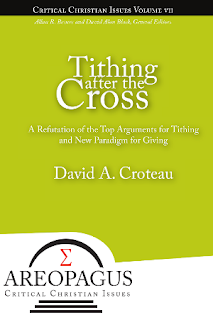
Over a year ago I was contacted by and old professor of mine, Dr. David Alan Black, and he requested that I write a book for the new publishing company he was editing for, Energion Publications. Specifically, he wanted me to write in the Areopagus Critical Christian Issues series on the topic of tithing. As some of you are aware, I have published two scholarly articles on tithing (co-written with Dr. Andreas Kostenberger: part 1 and part 2), a lengthy monograph called You Mean I Don't Have to Tithe?, and a four views book called Perspectives on Tithing. So, why did I agree to write another book on this topic?First, the monograph is very long, somewhat technical, though very documented. While there are over 1800 footnotes to support the research in You Mean I Don't Have to Tithe?, some people have found the prose too technical, the length too overwhelming, and the price too high (it's about $37 on amazon.com). It contains most of my thoughts on the subject, but it can be a little overwhelming.
Second, the chapter I wrote in Perspectives on Tithing is very limited. To go from over 300 pages to about 30 was a difficult task. I had to edit out so many thoughts that it made the argument less than convincing for some.
Third, while the monograph has almost all the content of this new book, Tithing After the Cross, the structure of this new book makes it an easy resource. See, the monograph is an inductive study on the issue, beginning with church history, then going through both the Old and New Testaments, and then theological systems. The new book is structured around the specific arguments for the continuation of tithing. So there are five categories of arguments: 1) Old Testament Arguments, 2) New Testament Arguments, 3) Theological Arguments, 4) Historical Arguments, and 5) Experiential Arguments. The arguments for tithing are discussed in order from weakest to strongest in each chapter. The book ends with a summary of principles for giving in the New Covenant. So, if there is a particular argument for tithing that you want to research and/or understand, you can easily access it in this book.
Fourth, this book was not written in scholar-ese. I attempted to make it understandable to lay people, not just pastors and scholars. It's under 100 pages in total length.
Fifth, this book is the most affordable. Right now amazon has the paperback on sale for $8.99 and the Kindle version for only $2.99. Now people won't have to take money away from their tithe in order to afford the book ... I'm just joking! :)
I'll end with some of the endorsements it has received:
Craig L. Blomberg, Ph.D.
Distinguished Professor of New Testament
Denver Seminary, Denver, CO
"David Croteau has already published a detailed study of all the significant biblical, theological and historical evidence for and against tithing as a mandatory practice for Christians. Here he distills the highlights of that research in brief, accessible form, responding to the most common arguments for tithing. Croteau convincingly demonstrates that believers after Jesus’ death and resurrection are not required to give ten percent. Instead they are exhorted to generosity and sacrifice, which for a few Westerners may be less than ten percent but for many of us means much more. Here is essential reading for the Christian who wants to be
biblically obedient!"
Andy Naselli, Ph.D.
Assistant Professor of New Testament and Biblical Theology
Bethlehem College and Seminary, Minneapolis, MN
"This book is thoughtful, clear, pastoral, convincing, and convicting. It does not lead to a position that Christians should give less than ten percent. Rather, (a) if the foundation of giving is our relationship with God and the grace and love he gives us and (b) if the amount we give is based on our income, what we determine
in our heart, the needs of those ministering to us and of fellow Christians, and generosity, then why give only ten percent?"
Michael A. Grisanti, Ph.D.
Professor of Old Testament
The Master’s Seminary, Sun Valley, CA
"David Croteau has provided the Church a concise and helpful argument for a biblical approach to giving for modern times. By contending that God does not require tithing for believers today, Croteau does not seek to minimize the giving of God’s people. Rather, he wants people to give in accordance to the pattern provided
by the Scriptures: generously, cheerfully, and sacrificially. May God’s people understand that we should not limit our giving to 10% of our resources, but to give in light of God’s abundant mercy and grace toward us."
George Athas, Ph.D.
Dean of Research and Senior Lecturer in Old Testament Moore Theological College, Sydney, Australia
"With sharp simplicity, David Croteau exposes a range of assumptions that many Christians employ in their thinking about tithing. He demonstrates how these assumptions can appear to be biblically based, and yet surprisingly be flawed. Croteau then uses sound biblical principles to shape a wise and godly attitude towards financial giving for the Christian. His concern for biblical faithfulness and God’s grace is evident throughout, and his explanations are enlightening and encouraging. Croteau is to be commended for serving the Christian community with these valuable (pun intended!) insights on what can be a controversial or even burdensome topic for believers."
Robert L. Plummer, Ph.D.
Professor of New Testament Interpretation
The Southern Baptist Theological Seminary, Louisville, KY
"There are many soundbites on tithing, but few exegetical studies - even fewer that are understandable to the average layperson, well-written, and concerned about the practical generosity of God’s people. Well, there may only be one book that fits that description, and you’re holding it in your hands."
Russell S. Woodbridge, Ph.D.
co-author of Health, Wealth & Happiness: Has the Prosperity
Gospel Overshadowed the Gospel of Christ
"If you want a concise overview of a better way to give generously to the Lord, then this book is for you. Dr. Croteau has provided a resource for the church to examine biblical principles for giving today. He fairly responds to the arguments for tithing today, and winsomely presents his view of grace-driven giving. Whether or not you believe tithing is still applicable today, this book will help you sort through the issue, and become a more generous giver."
Sunday, July 07, 2013
The San Francisco Plane Crash
I had a wonderful, but exhausting week, in South Korea. I was invited to teach through Paul's Epistle to the Philippians on Jeju Island just off the coast of mainland South Korea. I would be speaking to about 25 college-aged students from South Korea, Japan, and the United States at the Word of Life Bible Institute. Saturday began with a drive to the Jeju airport, followed by a quick 1 hour flight to Gimpo Airport in Seoul. After a bus ride across town, I arrived at the Incheon Airport in Seoul for my United Airlines flight to go home. We were flying through San Francisco.
I actually went to high school in the Bay Area (Foothill High School in Pleasanton, CA) and received my M.Div. from Golden Gate Baptist Theological Seminary just north of San Francisco in Mill Valley. So the area brought back a lot of fond memories, including the first apartment my beautiful bride and I lived in: a one-bedroom coming in under 500 square feet. This planned layover at SFO would be short: about 2 hours. No time to visit friends.
Our plane arrived about 20 minutes early. The pilot joked at how rare that was and asked us to excuse them for the next time we traveled when they would be their typical 5-10 minutes late. So at 11:05am we touched down, a very rough landing that the pilot tried (in vain) to joke about ... not very funny. Regardless, I needed to get through immigration, get my bag, and get rechecked in and go through security in under 90 minutes. So I rushed through everything and in record time, getting to my 1:00pm flight gate at 11:45am.
As I approached the gate, I saw a crowd at the window looking outside taking pictures and video. I wondered: "Haven't these people ever been to an airport?" It was odd to see them so fascinated with the plane that I figured was pulling up to the gate. As I smirked I looked out the window and saw this ...
That was when I noticed: everyone was silent and serious. After a minute or two, I asked someone what happened. The first of many pieces of misinformation I would receive that day: "The plane was taking off and it crashed." In fact, the plane was landing, but I didn't find that out for some time. We all were just staring out, waiting for the inevitable: the cancellation of our flights. And then they came ...
We all were told to go re-book our flights. The problem was, the airline had no idea when the airport would re-open. So I quickly rescheduled my flight for 10:15pm that night.
While waiting for the 10:15 flight, I went in to a restaurant to grab a bite to eat and watch the news. When I saw the picture on the screen I started to shake: the plane that crashed took off from South Korea at the same time as mine and was one of the options I had looked at for flights. If our plane had not been early, we would have been landing at right about the same time. I don't know exactly what I was feeling, except a sense that I had been close to death. In reality, I was safe in my Heavenly Father's arms. But that (truer) reality didn't kick in for a few minutes.
Rumors circulated that the plane had done cartwheels, that no one had died, that 60 had died, that 2 had died, that an engine had failed on descent, that no planes were leaving SFO until Monday, etc., etc. Eventually my 10:15 flight was cancelled. So I got back in line again. This time I was told that all flights from SFO, Oakland, and San Jose were book for Saturday, Sunday, and Monday. It might not be until Friday until we all can get out of the Bay Area. I quickly called the phone number given to me and took the first flight out of Oakland: Monday at 6:00am.

Now I needed a place to stay. I asked the airline if they could provide a voucher since I was getting a connecting flight (most people around me were flying out of SFO, not connecting). They said that since the situation wasn't there fault, I was on my own. So, my precious wife got on Facebook to reach out to friends around San Fran. An old friend, Brad, called and invited me to stay at his house. He gave me directions on how to take the shuttle to his place, but at that point I had been up for almost 24 hours straight (I can't sleep on planes). I found my way to the shuttle. After driving for about 25 minutes I asked the person in front of me: "Please tell me we've been here before" (I thought my exhaustion finally got to me!). She informed me that we were driving in circles, around and around the airport until the shuttle filled up. So, after about four circles, we finally left the airport. In all, it took almost 2 hours to get to the end of the line where my friend lives.
On the way we passed Golden Gate Baptist Theological Seminary, where I had studied from 1997-2000. From the freeway I could see the first apartment my wife and I lived, a restaurant where we had a date (right next to the Ferrari dealership), and many other places of memories past. Every 2-3 minutes I would smile large and sigh as I had a memory of a place. It had been 13 years since I had seen this area, but there were a lot of good memories.
I went to bed rather quickly and woke up over 11 hours later. We talked for about four hours, enjoying great conversations about Exodus International (he had been on staff there in the 90s), Rob Bell, spiritually abusive churches, the emerging/emergent church, his writing projects, my writing projects ... all stuff from the past 13 years we wanted to catch up on! However, we didn't have a way for me to get to the Oakland Airport Monday morning, until a high school friend of my wife's called.
C.J. is a fireman in San Fran. He was actually on a boat at the airport the previous day searching in the water for any survivors. He came to Novato (25 minutes north of the Golden Gate Bridge) and took me to his house near Oakland to stay for the night. Now I'm preparing for bed for an early (4am) taxi ride to the airport. If tomorrow goes well, I'll have started my trip in Jeju at 9:45am and it'll (Lord willing) end in Columbia, SC tomorrow at about 6 or 7pm. I think that's like almost 70 hours, but the time zones are rather confusing for me!
Please pray for a safe, quick trip tomorrow. I really miss my family.
I actually went to high school in the Bay Area (Foothill High School in Pleasanton, CA) and received my M.Div. from Golden Gate Baptist Theological Seminary just north of San Francisco in Mill Valley. So the area brought back a lot of fond memories, including the first apartment my beautiful bride and I lived in: a one-bedroom coming in under 500 square feet. This planned layover at SFO would be short: about 2 hours. No time to visit friends.
Our plane arrived about 20 minutes early. The pilot joked at how rare that was and asked us to excuse them for the next time we traveled when they would be their typical 5-10 minutes late. So at 11:05am we touched down, a very rough landing that the pilot tried (in vain) to joke about ... not very funny. Regardless, I needed to get through immigration, get my bag, and get rechecked in and go through security in under 90 minutes. So I rushed through everything and in record time, getting to my 1:00pm flight gate at 11:45am.
As I approached the gate, I saw a crowd at the window looking outside taking pictures and video. I wondered: "Haven't these people ever been to an airport?" It was odd to see them so fascinated with the plane that I figured was pulling up to the gate. As I smirked I looked out the window and saw this ...
![]() |
| Picture from my phone at SFO on 7/6/13 |
![]() |
| Cancellations for incoming flights |
We all were told to go re-book our flights. The problem was, the airline had no idea when the airport would re-open. So I quickly rescheduled my flight for 10:15pm that night.
While waiting for the 10:15 flight, I went in to a restaurant to grab a bite to eat and watch the news. When I saw the picture on the screen I started to shake: the plane that crashed took off from South Korea at the same time as mine and was one of the options I had looked at for flights. If our plane had not been early, we would have been landing at right about the same time. I don't know exactly what I was feeling, except a sense that I had been close to death. In reality, I was safe in my Heavenly Father's arms. But that (truer) reality didn't kick in for a few minutes.
Now I needed a place to stay. I asked the airline if they could provide a voucher since I was getting a connecting flight (most people around me were flying out of SFO, not connecting). They said that since the situation wasn't there fault, I was on my own. So, my precious wife got on Facebook to reach out to friends around San Fran. An old friend, Brad, called and invited me to stay at his house. He gave me directions on how to take the shuttle to his place, but at that point I had been up for almost 24 hours straight (I can't sleep on planes). I found my way to the shuttle. After driving for about 25 minutes I asked the person in front of me: "Please tell me we've been here before" (I thought my exhaustion finally got to me!). She informed me that we were driving in circles, around and around the airport until the shuttle filled up. So, after about four circles, we finally left the airport. In all, it took almost 2 hours to get to the end of the line where my friend lives.
On the way we passed Golden Gate Baptist Theological Seminary, where I had studied from 1997-2000. From the freeway I could see the first apartment my wife and I lived, a restaurant where we had a date (right next to the Ferrari dealership), and many other places of memories past. Every 2-3 minutes I would smile large and sigh as I had a memory of a place. It had been 13 years since I had seen this area, but there were a lot of good memories.
I went to bed rather quickly and woke up over 11 hours later. We talked for about four hours, enjoying great conversations about Exodus International (he had been on staff there in the 90s), Rob Bell, spiritually abusive churches, the emerging/emergent church, his writing projects, my writing projects ... all stuff from the past 13 years we wanted to catch up on! However, we didn't have a way for me to get to the Oakland Airport Monday morning, until a high school friend of my wife's called.
C.J. is a fireman in San Fran. He was actually on a boat at the airport the previous day searching in the water for any survivors. He came to Novato (25 minutes north of the Golden Gate Bridge) and took me to his house near Oakland to stay for the night. Now I'm preparing for bed for an early (4am) taxi ride to the airport. If tomorrow goes well, I'll have started my trip in Jeju at 9:45am and it'll (Lord willing) end in Columbia, SC tomorrow at about 6 or 7pm. I think that's like almost 70 hours, but the time zones are rather confusing for me!
Please pray for a safe, quick trip tomorrow. I really miss my family.
Thursday, May 30, 2013
Is 10% a "Good Place to Start"?
In a recent article, John Ortberg said: "Tithing is a bad ceiling but an excellent floor." In fact, I've heard many pastors say that while they can't prove that tithing is mandated for Christians, or that while they (only) think it is (they are a little unsure), it's still "a good place to start". First, why would they claim it's a good place to start? Second, is it really a good place to start? This second question digs in to why this really can be an important issue in the life of church members.
1) WHY THE CLAIM?
Two main reasons come to mind. First, they misunderstand tithing in the Mosaic Law and think that it was 10% of income. We never see any example of a person commanded to give 10% of their regular income nor any example of someone doing that. Neither Abraham, Jacob, Old Testament Jews, or Jews in the New Testament are described this way. The literature between the Old and New Testament don't describe Jews tithing in this way and Josephus (late 1st century) doesn't describe Jews tithing in this way. Second, some have recognized that Jews never gave 10% of income, but when they get to the New Testament, they appear to be "mesmerized" by the English dictionary definition of the word "tithe" being "10%". They seem to just fail to connect the dots.
2) IS 10% A GOOD PLACE TO START?
Here are my reasons for YES:
- easy to calculate
- not unreasonable for most
- sounds biblical
- if every Christian did it, the financial needs of the church would be easily met
Here are my reasons for NO:
- It is unfair. If Bob the Christian makes 1 million dollars a year and Joe the Christian makes $20,000 a year, giving 10% is financially easy for Bob, but brutally difficult for Joe. After giving 10%, Bob still has $900,000 to live and Joe only has $18,000. Joe's gift would be very generous and sacrificial; Bob's gift would sound very generous to our ears, but wouldn't be sacrificial in comparison.
- It is unreasonable for some. There are some people who have no business giving 10% of their income. Whether it's unforeseen medical bills, a tragic accident, or a job loss, we have a huge percentage of Christians in significant debt today (sometimes they are in debt because of foolishness and/or materialism, of course). I've heard pastors say that if you give 10% regularly, then God will take care of you financially. That is true for some, but for others, people I've know who have given far beyond 10%, some have ended up filing for bankruptcy! All the while praising God for "taking care of them"! I've heard many pastors say "You can't out give God," but I've actually seen people who gave so foolishly that they DID out give God. I know that sounds so offensive to many, but God has given us a brain between our ears and He expects us to use it. When you keep giving 10%, or 12%, or 14% while sinking deeper and deeper in to debt, something needs to change! This is not an isolated issue, either. Simply search online for stories about people going bankrupt who were tithing ... you find a lot of stories. You'll even get to read about the government writing and changing laws about tithing while filing for bankruptcy. The problem has become so widespread that the federal government has needed to get involved.
- While the word "tithe" means "10%," and while the word "tithe" is used many times in Scripture, is does not logically follow that Christians are required to give "10% of income." There are many things in Scripture both described in stories and prescribed/commanded in the Mosaic Law that do not directly apply to Christians: the Levirate Law, circumcision, Saturday sabbath keeping, etc. What we do not see in Scripture is any pattern of giving 10% of regular income on a regular basis. In fact, we don't see even one story of this.
- While tithing sounds and even feels so pragmatic, while it seems that the church would have so much money if only people tithed, that is not a good reason to require it or even strongly recommend it as a place to start.
- Saying that 10% is a good place to start ends up robbing people. We have two groups that get robbed: 1) The poor are fleeced of money they need for food and shelter. 10% is too high of a burden for some. I could paint this picture in pages upon pages, but I'll spare you. Let me simply say: even the Old Testament law had a lower requirement for giving for those who were poor: if you were not a land owner, you did not pay anything in tithes. 2) The rich are robbed of the blessings they could have by following the New Testament principles for giving. Someone making 1, 5, or 10 million dollars a year should never think that he has satisfied some biblical mandate or concept by giving 10%. In fact, when I've had the privilege to teach New Testament principles in local churches, I'll hear a story about someone making a modest income (less than $100,000 a year) deciding to up their giving to 30% or more! The "10% of income" concept, even when presented as a starting point, becomes a bullhorn that tells the wealthy "don't worry about giving much beyond 10%, you've met the requirement!" Again, this becomes the mindset EVEN WHEN THE PASTOR SAYS IT'S THE "floor of giving" (a concept I disagree with).
Therefore, for some, it is not an excellent floor. Now recognize this: I'm not saying that God wants you to give less then 10%, regardless of your financial situation. He may want you to step out in faith and trust Him. However, He also may want you to learn to be wise and cut back on your giving. Each situation is different, but following the New Testament principles of giving will lead to truly generous, sacrificial, and joyous giving. 10% shouldn't be considered the floor NOR the ceiling.
1) WHY THE CLAIM?
Two main reasons come to mind. First, they misunderstand tithing in the Mosaic Law and think that it was 10% of income. We never see any example of a person commanded to give 10% of their regular income nor any example of someone doing that. Neither Abraham, Jacob, Old Testament Jews, or Jews in the New Testament are described this way. The literature between the Old and New Testament don't describe Jews tithing in this way and Josephus (late 1st century) doesn't describe Jews tithing in this way. Second, some have recognized that Jews never gave 10% of income, but when they get to the New Testament, they appear to be "mesmerized" by the English dictionary definition of the word "tithe" being "10%". They seem to just fail to connect the dots.2) IS 10% A GOOD PLACE TO START?
Here are my reasons for YES:
- easy to calculate
- not unreasonable for most
- sounds biblical
- if every Christian did it, the financial needs of the church would be easily met
Here are my reasons for NO:
- It is unfair. If Bob the Christian makes 1 million dollars a year and Joe the Christian makes $20,000 a year, giving 10% is financially easy for Bob, but brutally difficult for Joe. After giving 10%, Bob still has $900,000 to live and Joe only has $18,000. Joe's gift would be very generous and sacrificial; Bob's gift would sound very generous to our ears, but wouldn't be sacrificial in comparison.
- It is unreasonable for some. There are some people who have no business giving 10% of their income. Whether it's unforeseen medical bills, a tragic accident, or a job loss, we have a huge percentage of Christians in significant debt today (sometimes they are in debt because of foolishness and/or materialism, of course). I've heard pastors say that if you give 10% regularly, then God will take care of you financially. That is true for some, but for others, people I've know who have given far beyond 10%, some have ended up filing for bankruptcy! All the while praising God for "taking care of them"! I've heard many pastors say "You can't out give God," but I've actually seen people who gave so foolishly that they DID out give God. I know that sounds so offensive to many, but God has given us a brain between our ears and He expects us to use it. When you keep giving 10%, or 12%, or 14% while sinking deeper and deeper in to debt, something needs to change! This is not an isolated issue, either. Simply search online for stories about people going bankrupt who were tithing ... you find a lot of stories. You'll even get to read about the government writing and changing laws about tithing while filing for bankruptcy. The problem has become so widespread that the federal government has needed to get involved.
- While the word "tithe" means "10%," and while the word "tithe" is used many times in Scripture, is does not logically follow that Christians are required to give "10% of income." There are many things in Scripture both described in stories and prescribed/commanded in the Mosaic Law that do not directly apply to Christians: the Levirate Law, circumcision, Saturday sabbath keeping, etc. What we do not see in Scripture is any pattern of giving 10% of regular income on a regular basis. In fact, we don't see even one story of this.
- While tithing sounds and even feels so pragmatic, while it seems that the church would have so much money if only people tithed, that is not a good reason to require it or even strongly recommend it as a place to start.
- Saying that 10% is a good place to start ends up robbing people. We have two groups that get robbed: 1) The poor are fleeced of money they need for food and shelter. 10% is too high of a burden for some. I could paint this picture in pages upon pages, but I'll spare you. Let me simply say: even the Old Testament law had a lower requirement for giving for those who were poor: if you were not a land owner, you did not pay anything in tithes. 2) The rich are robbed of the blessings they could have by following the New Testament principles for giving. Someone making 1, 5, or 10 million dollars a year should never think that he has satisfied some biblical mandate or concept by giving 10%. In fact, when I've had the privilege to teach New Testament principles in local churches, I'll hear a story about someone making a modest income (less than $100,000 a year) deciding to up their giving to 30% or more! The "10% of income" concept, even when presented as a starting point, becomes a bullhorn that tells the wealthy "don't worry about giving much beyond 10%, you've met the requirement!" Again, this becomes the mindset EVEN WHEN THE PASTOR SAYS IT'S THE "floor of giving" (a concept I disagree with).
Therefore, for some, it is not an excellent floor. Now recognize this: I'm not saying that God wants you to give less then 10%, regardless of your financial situation. He may want you to step out in faith and trust Him. However, He also may want you to learn to be wise and cut back on your giving. Each situation is different, but following the New Testament principles of giving will lead to truly generous, sacrificial, and joyous giving. 10% shouldn't be considered the floor NOR the ceiling.
Wednesday, May 29, 2013
Tithing and Church History (Response to DeYoung part 8)
Historical
Theology can be a tricky discipline. It isn't enough to simply list
people off who agree with your particular theological stance. Even
giving a citation could be misleading. Instead, getting to the reason
they believed what they believe is important. Too many times the
reasoning has been left out of the discussion with tithing.
Other times a more full-orbed perspective on the ancient document
or person is needed to grasp their reasoning.
DeYoung
cites three historical sources that advocate tithing: the Apostolic
Constitutions, Irenaeus, and Augustine. Let's look at those in order.
1)
The Apostolic Constitutions
(300s)– This document truly is an
early and strong advocate for tithing. Two things
should be considered when citing this document for tithing. First,
the Constitutions
equated/likened bishops to priests and Levites and the tabernalce to
the Holy Catholic Church. Those two views seem to have driven its
stance on tithing. If you disagree with either of those views, you
may want to reconsider using this document as a source to back up
your views on tithing. Second, in the introductory notice to the
Ante-Nicene
Fathers
(Volume 7), on page 388, the editors noted that books 1-6 are the
earliest portions, with book 7 being “somewhat later,” though
still very old. The portion in the Apostolic
Constitutions
that contains the advocacy for tithing is found in book 7. Also,
DeYoung rightly notes that the section in the Constitutions
that advocates tithing says to utilize “freewill offerings” to
support the poor. However, it should be noted that tithing was used
for this function in the Old Covenant.
![]() |
| Irenaeus |
2)
Irenaeus (died in 200 A.D.) - Admittedly, the quote from Irenaeus
given by DeYoung (from Against Heresies,
4.18.2) is a difficult one to interpret. DeYoung believes that
Irenaeus was mandating tithing. However, note these scholars who
appear to differ from DeYoung's interpretation of the ambiguous
Irenaeus quote:
-
Powers (dissertation titled “An Historical Study of the Tithe in
the Christian Church to 1648”) said: “the whole spirit of
Irenaeus was that the law of the tithe had been abrogated” (Powers,
page 21).
-
Charles Feinberg (in The Zondervan
Pictorial Encyclopedia of the Bible,
5:758) concluded only that the church fathers emphasized Christian
freedom in giving.
-
Stuart Murray (Beyond Tithing,
99-101, 106) said that Irenaeus rejected tithing.
Irenaeus'
quote, when read in context, is much more ambiguous than DeYoung
leads on.
![]() |
| Augustine |
3)
Augustine (around 400 A.D.) - I readily admit that Augustine did
truly advocate tithing. But two factors need to be considered. First,
Augustine clearly misunderstood the Old Testament's teaching on
tithing. He is crystal clear in his belief that Jews gave 10% of
their income under the Mosaic Law. This misunderstanding of
Augustine's fed into his advocacy for tithing. Second, Augustine
believed (and practiced) that Christians should sell their
possessions and give the proceeds to the poor. This is truly the
command of Christ. However, since Christians are so unwilling to do
that, they should at least give what the scribes and Pharisees gave,
especially since our righteousness needs to exceed that of the
scribes and Pharisees. That is a summary of Augustine's teaching. So
recognize his view that tithing isn't really the command for
Christians, but sell everything and give the proceeds to the poor. He
actually lessened the command down to only 10% of income. I've never
actually heard someone utilize that argument in a pulpit, but that
was Augustine's. Jerome, John Chrysostom, and Augustine all argued
that way.
So
while those three sources argued for the continuation of tithing (and
there are more), what DeYoung did not mention in his sermon were the
early sources that went in the other direction, arguing against the
continuation of tithing. I'm not going to get into the specifics of
their reasoning (as I don't necessarily agree with how they reach
their conclusions and I've done this already in You
Mean I Don't Have to Tithe?), but here
are a few early sources arguing against the continuation of tithing:
![]() |
| Epiphanius |
1)
Didascalia Apostolorum
(about 225 A.D.)
2)
Origen (died about 255)
3)
Epiphanius (about 370) – This last ancient source, though he is not
well-known today, is interesting as he was known as a defender of
orthodoxy.
After
studying the doctrine of tithing throughout church history, I've
concluded that their were godly men on both sides of this debate. The
early church was divided in her views, in the Middle Ages advocacy
for tithing grew, but division occurred leading up and in to
the Reformation. There has not been a consistent view on this issue
over the last 2,000 years. The key thing to remember when studying
tithing (or other doctrines) in church history is not so much “who
concluded what” but more “why and how did they come to that
conclusion.” Then we can weigh their arguments and not just say
“I'm with Augustine” or “I'm with Epiphanius”!
This
series will have one more concluding post.
Tuesday, May 28, 2013
Tithing and Biblical Theology (Response to DeYoung part 7)
DeYoung
stated: “How you view tithing has a lot to do with how you view the
Old Testament.” This a great transition in his sermon into the area
of biblical theology. In fact, what makes the tithing topic fascinating to
me as a scholar is its relationship to biblical theology. As a
Christian layperson, I'm more curious about how this topic should
influence my financial giving to the local church and other Christian
ministries. But it is where this topic touches biblical theology that
really fascinates me.
DeYoung
stated: “I would say every law from the Mosaic Covenant remains and
every law must now be understood in light of Christ's coming.” We
are in complete agreement on this point. I'm not one of those who say
that the Old and New Covenants have no relationship between them.
DeYoung refers to those who might say “rip out that page” when
referring to the Mosaic Law. While I might be an ardent advocate for
grace giving (or, post-tithe giving), I find a tremendous amount of
value in the Mosaic Law ... each and every law. And when I read a law
that I don't find much value in, I realize that the problem is with
my lack of understanding, not the law itself.
Some views on the relationship between the Mosaic Law and Christians
Some
say: Every law that is not repeated is repealed. That's the basic
stance of some in the dispensationalist camp, particularly older
forms like Classic Dispensationalism (think Scofield and Chafer) and
Revised Dispensationalism (think Ryrie).
Some
say: Every law that is not explicitly repealed continues. That is the
basic stance of some in the reformed/covenant theology camp.
Some
say: The law has three parts: civil, ceremonial, and moral. The civil
laws don't apply because we are not the nation of Israel, the
ceremonial laws don't apply because Christ fulfilled them, but the
moral laws all still apply.
I
think the first two views are overly simplistic. In the third view, I
reject that three-fold division. My view (developed from a J. Daniel
Hays article in Bibliotheca Sacra) is that every law in the
Old Covenant is a manifestation of God's eternal character, therefore
every law applies to Christians. But in order to figure out HOW each
law applies, we need to get to the underlying principle of the law.
The laws, as they are manifested, give the earmarks of being
manifested for a particular people at a particular time in a
particular place under a particular covenant. So when laws are tied
to cultural or covenant aspects that are not directly relevant for
New Covenant believers, the way the law applies will be changed ...
but that doesn't mean it doesn't apply.
Tithing
is connected to: the Levites, priesthood, festivals, and land (and
possibly other things as well). All four of those Old Covenant
entities are not directly applicable in their Old Covenant
manifestation to Christians. We don't have Levites in the church, the
priesthood has changed significantly as we are the priests, the
festivals, which were pointers to New Covenant realities, have been
fulfilled and are no longer literally celebrated, and our
relationship to the land has drastically changed. This greatly
impacts the issue of the continuation of tithing today.
Furthermore,
two specific things that DeYoung states need comment. 1) “So when
we look at tithing I don't think there is anything in the coming of
Christ that would set apart, that would remove the principle of
tithing, but rather should intensify.” I totally agree with this
statement in a vacuum, but he seems to believe that the “principle
of tithing” is the idea of giving 10% of income, a concept that
seems TOTALLY FOREIGN to anything in Scripture. You can't assume the
underlying principle, you need to prove it. 2) He states that we are
not an agrarian society. I've already responded to this, but this is
a common and (apparently) compelling argument by those who mandate
tithing for Christians. However, first century Israel was not an
exclusively agricultural society, and neither was Israel of Moses'
day. Even back in Genesis we see references to money and those who
worked trades other than agriculture: Tubal-cain (Genesis 4:22)
worked with bronze and iron. While I recognize that the society was
more agriculturally based back then, it wasn't exclusively
agricultural. That should lead to the question: if an Israelite made
money/income apart from crops or cattle, does the Old Testament
mandate him to tithe? The answer is: no. Why, because of the
extremely tight connection between the land and tithing.
Next
we'll look at the three references DeYoung made to tithing in church
history.
Monday, May 27, 2013
Hebrews 7, Melchizedek, and Tithing (Response to DeYoung part 6)
DeYoung
does a fine job putting Hebrews 7 in context. He recognizes that the
author of Hebrews is really trying to prove that Jesus is a superior
high priest and that Jesus was in the order of Melchizedek and not of
Aaron or the Levites. Then DeYoung says this: “And though the
chapter is not about tithing, I think there is a fair implication
that if the people of God tithed to the Levitical priests, and if
Abraham tithed to Melchizedek, a king and a priest, would not
Christians now tithe to the high priest and king of the church? The
analogy is not that you tithe to your pastor, but you tithe to the
Lord Jesus Christ who is a superior priest.”
DeYoung
believes this is a “fair implication,” therefore he seems to
agree that this is not the point of the passage. However, let's look
at his specific argument that it is a “fair implication.”
-
people of God tithed to Levitical priests
-
Abraham tithed to Melchizedek (a priest)
-
Christians tithe to Jesus (a superior priest)
The
problem here is three-fold:
1)
When the people of God “tithed” to the Levitical priests, how
much of their income did they give? Think about this for a minute:
how much of their income did they give? If you know the answer
to that, you are smarter than I am! They did give about 23% yearly
from their crops and cattle, but if they made any income by other
means (fishing, arts, building, etc.) they were not required to give
anything from that. And since the animal tithe probably was only
rarely actually 10% (read Leviticus 27:30-32 closely), no one really
knows how much was required in this “tithe”.
2)
How much of his regular income did Abraham tithe to Melchizedek? The
answer: we don't know. We read of one story of Abraham giving 100% of
the bounty of war away, with 10% of that going to this priest/king
Melchizedek. But we don't know that Abraham EVER gave 10% to any
priest again. There is no indication that this was a pattern or
habit.
3)
If we are to follow this pattern, then which one should we follow?
Give 23% of our crops and cattle? Give 10% from the spoils of war?
Neither of these examples is “10% of income,” so how is this a
“principle” or “pattern” for us today?
I
think DeYoung's “fair implication” has some significant problems.
He then cites New Testament scholar Reggie Kidd saying that the
biblical story seems to include “tithing principally” even if
there will be adjustments “in the New Covenant situation.” I
honestly have no problem with the idea of a tithing principle, but
the content of that principle is the issue. Why is the principle “10%
of income” when that was never practiced regularly by anyone in
Scripture? It seems to me that each of the tithes in the Mosaic Law
may have their own principles. For example, if the Festival Tithe was
given to teach the “fear of the Lord,” (Deuteronomy 14:23) then
that is the underlying principle: fear the Lord in the area of your
finances and you've kept the underlying principle to the Festival
Tithe. What would make someone think that the “10% of regular
income” concept would continue, when that is not present in the
Abraham narrative nor the Mosaic Law?
Next
we'll briefly look at DeYoung's discussion on how tithing fits into
one's view of biblical theology.
Friday, May 24, 2013
Paul and Tithing (Response to DeYoung part 5)
While DeYoung notes
that when Jesus said the words contained in Matthew 23:23 He was
still under the Old Covenant, he quickly points us to 1 Corinthians
9:13-14. I'm very impressed by DeYoung's reference to this verse. In
my book You Mean I Don't Have to Tithe?, I list twenty
arguments for tithing in order of weakest to strongest, and this
verse was the second strongest argument for tithing (in my opinion)
and it is hardly ever utilized in pro-tithing resources.
As is usually the
case, paying close attention to context will radically change the way
this verse is used, however. Sometimes we have difficulty
understanding the context of a passage because the chapter break was
placed in an unfortunate spot. This is one of those examples. See,
the content of 1 Corinthians 8 is essential for understanding what
Paul is trying to communicate in 1 Corinthians 9.
1 Corinthians 8 is
Paul discussing food sacrificed to idols. In short, he says that
while there is nothing inherently wrong with eating food that has
been sacrificed to an idol, if it causes your fellow Christian to
stumble, you should not act on the right to eat the food. So, Paul
says to restrain your liberty if it hinders your fellow Christian. 1
Corinthians 9 begins with an ILLUSTRATION of restraining liberty. It
is not a new topic, but a continuation of 1 Corinthians 8.
So Paul says in 1
Corinthians 9 that those who work have a right to receive wages; he
then gives several proofs of this concept; and then he explains that
he restrains his liberty/freedom/right to get wages for the sake of
other Christians.
Structure of the
Argument
I. Discussion on
food sacrificed to idols
II. Conclusion:
restrain your liberty for the sake of other Christians
A. Illustration
1. Workers
deserve wages
a)
Arguments from the natural order
1)
soldiers receive wages
2)
farmers receive wages
3)
shepherds receive wages
b)
Arguments from the Old Testament
1)
Deuteronomy 25:4 and oxen who tread out the grain
2)
priests who served at the altar
2.
Conclusion to Illustration: vs. 15: “But I have made no use
of any of these rights ...”
This
is the context of the argument. So, could Paul be arguing that
ministers of the gospel (vs. 14) should be paid “in the same way”
as priests? In saying that you encounter several problems, including
that you would have to disconnect the previous four arguments from
“in the same way” and assume that Paul is now ONLY building off
of the last one. But there are three OTHER problems with leveraging
this verse for tithing:
1)
No priest received ten percent of his income from the Israelites. I
discussed earlier the “priestly tithe” mentioned in Numbers 18
for this very reason: priests received a “tithe of the tithe,”
or, one percent. Of course, since multiple tithes were given, that
wouldn't be the total contribution received by the priest. So, if
this verse is arguing that ministers of the gospel should be paid
like priests, then they receive about 2.3 percent, not ten (that's
ten percent of the 23% received by the Levites). Sadly and
ironically, this is about the average giving today.
2)
The overarching context is about rights and forgoing rights. Notice 1
Corinthians 9:15 above where Paul explicitly says he has “made NO
USE
of any of these rights.” Now, if this is stating that ministers of
the gospel should receive 2.3 percent in contributions, that would
have to be explained alongside of the idea that Christians would only
need to give 2.3 percent if the pastor did not forgo his right to a
salary. In other words, it's not that Christians HAVE TO give this
“2.3 percent tithe,” but they only have to give it if the
minister of the gospel decides he wants a salary.
3)
If you thought what was just written was a little confusing ... then
good! It is true that tithing was not a strictly Jewish practice.
However, the way Gentiles practiced tithing varied GREATLY from
Jewish tithing. So, if Paul was going to incorporate the Mosaic Law
of tithing into the New Covenant, an he would need to explain to both
Jews and Gentiles how it would carry over ... but especially for the
Gentiles. How could Paul expect the Gentiles to have such a nuanced
understanding of the Mosaic Law?
While
DeYoung has utilized the best Pauline verse for tithing in his
sermon, this verse cannot carry the weight of the tithing argument.
DeYoung does cite other texts in 1 and 2 Corinthians, but none of
them explicitly nor implicitly refer to tithing. Next we will discuss
Hebrews 7:1-10 and Melchizedek's tithe to Abraham.
Tuesday, May 21, 2013
Old Testament Tithing Passages - Response to DeYoung (part 4)
TITHING PRE-LAW
DeYoung correctly notes that tithing
occurs before the giving of the Mosaic Law: “This principle of
tithing predates the Mosaic Covenant.” Of course, what exactly is
meant by “principle” is up for debate. He quickly covers Genesis
14 and 28. He concludes: “We do see that this principle of tithing
is operative even before the Law of Moses establishes it. This
principle that you would give a tenth of what you have to one who is
a superior king or priest above you.” This is an interesting way to
summarize Genesis 14 and 28. We see one example of someone giving 10%
from the bounty of war and then giving the other 90% a way as well.
We see another example of someone promising to give 10% of all his
possessions at some point in the future. The way DeYoung phrases
tithing is giving “a tenth of what you have” before the Mosaic
Law. Abram (Genesis 14 occurs before his name was changed to Abraham)
gave 10% of the bounty of war to Melchizedek, but it doesn't say 10%
of all his possessions. Jacob promised to give 10% of his
possessions, but most likely it was over 20 years before he
actually had to do it. So is tithing the giving to a superior 10% of
possessions or 10% of income. In Abraham's case, it's 10% of the
bounty of war. This is NOT what the Mosaic Law prescribes in Numbers
31:28, which says that from the spoils of war an Israelite had to
give 1/500. So if the idea of giving a tenth is some universal, God
given principle, then why do the Israelites only give 1/500 from the
spoils of war? Wouldn't this verse undermine the concept that “10%”
is bound up with an eternal giving principle called tithing? And Jacob promised to give 10% of all he possessed when God kept His side of the deal. Does that mean that people back then would give 10% of their possessions, not 10% of their increase? Is that the "principle" to be understood? Should that be practiced today?
THE THREE TITHES
DeYoung says “There were actually
three different tithes required in the Old Testament.” It is true
that the Israelites in general had to give three distinct tithes, but
there is a fourth required tithe: the priestly tithe. This is a tithe
required of the Levites. They would take 10% of what they were given
through tithes and give that to the priests. This is not really a
critique of DeYoung, as it wasn't really necessary to include that in
his sermon, but more of a clarification on tithing in the Mosaic Law.
His understanding and description of
the three tithes was quite well done. It was very impressive to see
how well he understood the differences between the Levitical,
Festival, and Charity tithes. He concluded that Israelite tithing
totaled about 23% on a yearly basis. Not including the Sabbatical
Year in the calculations, I would agree that 23% is about the yearly
giving in tithes for the ancient Israelites.
He gives an interesting possible
understanding connecting Matthew 23:23 with the three tithes (where
justice = the Levitical tithe, mercy = the Charity tithe, and
faithfulness = the Festival tithe). Then he has a few statements that
puzzle me in the conclusion to this discussion:
1) “Even if that's not the case, and
there's no way of knowing for sure ...”
2) “Jesus reinforces this principle
that you ought to have tithed.”
3) “Now a tenth is the amount.”
Why are we unsure about the amount
Jesus was referring to? What could possibly be the justification for
thinking that Jesus had anything in mind except the 23% idea? If he
was referring to the tithing laws I discussed in a previous post,
those found in the Mishnah, then it would be a 20% tithe. So if Jesus
is reinforcing a “tithing principle” in Matthew 23:23, it would
be anything but 10%. So: how did we go from 23% to 10%? Where is the
justification for lowering the standard from the Mosaic Law's 23% all
the way down to a measly 10%? As many tithing advocates would ask: on
what basis would we expect God to require less in the New Covenant
than He required in the Old Covenant? If that is a valid argument
(which I doubt), then 23% is the standard, not 10%.
WAS TITHING IN THE OLD TESTAMENT 10% OF
INCOME?
When a pious Jew decided to faithfully
practice the tithing laws, did he give 10% of his income? I already
mentioned above that from the spoils of war only 1/500 was required,
but there are many more problems with this “10% of income” idea.
First, Leviticus 27 is very clear that the tenth animal that passes
under the rod must be given as a tithe. So if an Israelite has nine
cows, how many are given as a tithe? ZERO. If he has eleven cows, how
many does he give? ONE. In neither situation would he actually be
giving 10%. Notice also that it isn't the FIRST one that passes under
the rod, but the TENTH one. This could provide a challenge to
DeYoung's integration of the “principles” he found with
firstfruits with the “principles” he found in tithing. Second,
where does the Old Testament say “income” or “increase”? It
doesn't. It specifies certain products connected to the land that
must be tithed. It's this connection to the land of Israel that is
extremely important when analyzing the issue of tithing through the
grid of biblical theology. See, the overarching reason that God
required a tenth from certain products from the land is because God
himself provided the land for Israel. If an Israelite had an
increase/income that was NOT connected to the land, nothing in the
Old Testament says that they were to tithe on that. So, if an
Israelite made a plow for someone and was paid 10 shekels, they did
not have to tithe one shekel. That income was not connected to the
land. Third, while Israel was primarily an agricultural society, it
was not solely agricultural. Even in Leviticus 25 we see rules for an
ancient banking system (e.g. Lev 25:36). The book of Genesis contains
dozens upon dozens of references to money. So it wasn't like they
ONLY dealt in animals and crops. To say that there was a shift in the
economical system would be correct, but it wasn't a shift from “no
dealing in money” to “only dealing in money.” In summary: 1)
not all “tithing” was actually 10%, and Leviticus 27 makes this
crystal clear; 2) all tithing was connected to the land of Israel;
and 3) Israel's economic system may have been shifting, but
Israelites dealt in money way back in Genesis.Monday, May 20, 2013
However ... Matthew 23:23 (part 3)
Of course, as I've stated, I do not
agree with DeYoung's conclusion regarding the tithe. As I get in to
the specifics, I want you to understand that it is NOT because I
desire to give less than 10% myself. I've been accused of that many
times, but it is simply not true. My desire is to be faithful to
Scripture and I'm confident that DeYoung has that same exact desire.
A SQUISHY TERM
DeYoung consistently referred to the
“principle” of tithing in his sermon. What exactly does he mean
by “principle”? How does the “principle” differ from the
“law” of tithing? Is the principle the concept of “10%” or
simply giving? Is the underlying principle to tithing found in it
being an expression of a generous, sacrificial gift given to God in
recognition that everything belongs to Him or the actual 10% number?
Calling something a “principle” but never really parsing out how
it differs from “law” doesn't clarify, but muddies the water.
MATTHEW 23:23
DeYoung makes a significant contextual
observation about Matthew 23:23: “But if you look at verse 1 you
notice He's not just speaking to scribes and Pharisees, this isn't
just instruction for them, verse 1, Jesus said 'to the crowds and to
His disciples'. So though He's addressing scribes and Pharisees, He's
really speaking this in the hearing of people like us, the crowds,
the disciples. So this is what he wants everyone to hear, this isn't
just for the Pharisees.”
True, Matthew 23:1 says that Jesus was
speaking to “the crowds and to his disciples” (ESV). Note these
observations about the context of Matthew 23:
-verse 2-the scribes and Pharisees are
referred to in the third person
-the scribes and Pharisees are referred
to by the third person plural “they” in verse 3 (3x), verse 4
(2x), verse 5 (2x), verse 6 (1x)
-the “you” in verses 8-11 refers to
the crowds and disciples, Jesus' audience at this point
-verse 12 concludes the section
-verse 13 begins “But woe to you,
scribes and Pharisees”. This is a shift in the passage, as the
“you” before this referred to the crowds and disciples but NOW it
refers to scribes and Pharisees. So Jesus is in fact addressing the
scribes and Pharisees in this section.
DeYoung goes back too far in trying to
understand the context of the passage, missing the shift that takes
place in Matthew 23:13. Regardless, if those observations above
weren't convincing, note that even if Jesus were speaking to the
crowds and disciples, for DeYoung to say He was “really speaking
this in the hearing of people like us” is an over-flattening of
changes between the Old and New Covenants. I am NOT arguing for a
strong discontinuity between the Old and New Covenant like an old
school dispensationalist, but these crowds and disciples were still
under the Old Covenant when they were listening to Jesus' words. So
if Jesus tells Jews during His earthly ministry that they should be
tithing, why would that mean that Christians in the New Covenant
should be tithing? What would you expect Jesus to say at this point?
“Keep tithing for a year or two, but soon I will die on the cross
and the paradigm for giving to God will change”? That would have
severely distracted from Jesus' point, which was about the hypocrisy
of the scribes and Pharisees, not Christian tithing. DeYoung
concludes: “Jesus does not undermine the principle of tithing, he
does not reject it, he does not overturn it, he rather reaffirms it.”
Yes, he reaffirmed it for those under the Old Covenant (while I think
he reaffirmed it for the scribes and Pharisees, he thinks it was
reaffirmed for the crowds and disciples, but I don't know if this
matters too much). New Testament scholar Craig Blomberg concluded: “The last sentence of v. 23 does not imply … that tithing is mandated of Christians, merely that as long as the Mosaic covenant remains in force (up to the time of Jesus’ death and resurrection), all of it must be obeyed but with discernment of its true priorities” (Blomberg, Matthew, New American Commentary, 346).
But there is another problem with DeYoung's understanding of Matthew 23:23 (the material below is taken from chapter 3 in my forthcoming booklet: Tithing After the Cross). There is a legitimate debate about whether Jews were actually supposed to tithe mint, dill, and cummin. The Mishnah (a collection of rabbinic sayings and interpretations written down around 200-250, but some of the traditions date back to the period of Jesus' earthly ministry) contains this debate in Maaserot 4:5 ... specifically over coriander and dill: were they really liable to tithe laws? One rabbi (died ca. 120 A.D.) said dill needed to be tithed. Another passage, Shebiit 9:1, concluded that small plants were exempt from tithing laws. It is VERY important to understand this so we actually know what Jesus was commending: faithfulness to the Old Testament law or faithfulness to Jewish oral traditions? The parallel to Matthew 23:23 is Luke 11:42 and in that parallel Jesus said "and every kind of garden herb." One thing truly is clear from the Mishnah: it wasn't necessary to tithe EVERY herb. Therefore, the most likely understanding of Matthew 23:23 and Luke 11:42 is that Jesus was commending the Jews for being meticulous, but He is NOT commending obedience to the Old Testament law or practice.
REGARDLESS, even IF Jesus was commending the Mosaic Covenant laws, then he was commending a 23 percent tithe on crops from the ground and cattle, as DeYoung has acknowledged. How do we get from Jesus commending Jews for giving 23 percent of their crops and cattle to Jesus commending us to give 10 percent of our income? I'll deal with the idea that their was a change in the Israelite economic system later, but for now: how do we go from 23 percent of crops and cattle to 10 percent of income? Even if "crops and cattle" was an expression for income (which it is not), the change from 23 to 10 is huge! Why only 10 percent now? The word "tithe" obviously means 1/10, but DeYoung has stated that the Mosaic Covenant required about 23 percent per year. I just don't see how we get from 23 percent to 10 percent.
In the next post I will cover some of DeYoung's thoughts on tithing in the Old Testament.
REGARDLESS, even IF Jesus was commending the Mosaic Covenant laws, then he was commending a 23 percent tithe on crops from the ground and cattle, as DeYoung has acknowledged. How do we get from Jesus commending Jews for giving 23 percent of their crops and cattle to Jesus commending us to give 10 percent of our income? I'll deal with the idea that their was a change in the Israelite economic system later, but for now: how do we go from 23 percent of crops and cattle to 10 percent of income? Even if "crops and cattle" was an expression for income (which it is not), the change from 23 to 10 is huge! Why only 10 percent now? The word "tithe" obviously means 1/10, but DeYoung has stated that the Mosaic Covenant required about 23 percent per year. I just don't see how we get from 23 percent to 10 percent.
In the next post I will cover some of DeYoung's thoughts on tithing in the Old Testament.
Saturday, May 18, 2013
"Our Neglected Stewardship" by Kevin DeYoung (part 2)
On Mother's Day, 5/12/2013, Kevin
DeYoung preached a sermon titled “Our Neglected Stewardship” at
University Reformed Church in East Lansing, Michigan. DeYoung's
sermon was almost exactly 1 hour long. In this single sermon, he
covered:
-The reason his church needs to hear
this message
-The state of giving in the American
church
-Jesus' teaching on tithing in Matthew
23:23
-Pre-Mosaic Law passages on tithing
(both Genesis 14 and 28)
-The introduction to tithing in the
Mosaic Law: Leviticus 27
-Malachi 3
-The Three Mosaic Law Tithes in Numbers
18 and Deuteronomy 14
-The importance of firstfruits
-Israelite freewill offerings
-Paul's teachings on giving (1 Corinthians 9:13-14; 2
Corinthians 8:12; 2 Corinthians 9:1-5; 9:6; 1 Corinthians 16:1-2)
-Acts 4: offerings laid at the feet of
the apostles
-Hebrews 7:1-10
-The relationship between the Old
Covenant and New Covenant and how Christians should approach the Old
Covenant laws (biblical theology)
-Tithing in Church History: Apostolic
Constitutions, Irenaeus, Augustine
-7 Applications for his congregation
This is an INCREDIBLE amount of
material to cover. Seriously! The man touched upon EVERY major
passage of Scripture that discusses tithing in BOTH testaments, did
some biblical theology on the relationship between the covenants,
traced the topic (briefly) in church history, and applied his
teaching in extremely practical ways. That sounds like a ten part
series, not a single sermon. DeYoung is a great communicator and he has an
exceptional grasp of Scripture. As much as I disagree with his
conclusions in THIS sermon, listening to it made me desire to listen
to more of his preaching.
Let me give a few comments on where I
agree with DeYoung:
-I am also embarrassed that the
American church is giving about 2-3% of its income
-I am disappointed that only 12% of
Protestants tithe to their church
-We agree that the best reading of
tithing in the Mosaic Law is that there were three distinct tithes:
Levitical, Festival, and Charity
-We agree that Israelite tithing
equaled about 23% yearly (not including the Sabbatical year in the calculations)
-We are both repulsed by the prosperity
gospel
-I love this thought: “If you want to
be stingy towards God, God can be stingy towards you. And if you want
to be bountiful toward God, He has at His disposal the means to be
bountiful toward you.”
-He says: “How you view tithing has a
lot to do with how you view the Old Testament.” I think that is
very insightful and raises why this can be an important topic.
-He emphasizes giving to the local
church first; I think that is entirely in line with what I gather
from the New Testament
-Stewardship should be an important
aspect of discipleship
-He says: “Use your wallet to test
and to shape your heart.” Brilliant thought!
-His last application point is: “Excel
in the grace of giving because of God's grace to you.” I absolutely
adore the idea of giving in response to God's grace in our lives.
I don't get the sense that DeYoung has
thought lightly about giving, but that he has truly meditated on the
importance of giving in the life of a Christian.
Subscribe to:
Posts (Atom)


