Dallas Willard is loved by many evangelicals, especially those who are embracing the Emerging/Emergent Church. Here's a quote from his own website. This is a hypothetic discussion with a girl. Right at the end of the (hypothetical) discussion, she says:
"But I still struggle with how I should view those who have other beliefs. I'm not sure I am ready to condemn them as wrong. I know some very good Buddhists. What is their destiny?"
Dallas Willard ... on his own website ... responds:
"I would take her to Romans 2:6-10: 'God will give to each person according to what he has done. To those who by persistence in doing good seek glory, honor, and immortality, he will give eternal life. But for those who are self-seeking and who reject the truth and follow evil, there will be wrath and anger.'
What Paul is clearly saying is that if anyone is worthy of being saved, they will be saved. At that point many Christians get very anxious, saying that absolutely no one is worthy of being saved. The implication of that is that a person can be almost totally good, but miss the message about Jesus, and be sent to hell. What kind of a God would do that? I am not going to stand in the way of anyone whom God wants to save. I am not going to say 'he can't save them.' I am happy for God to save anyone he wants in any way he can. It is possible for someone who does not know Jesus to be saved. But anyone who is going to be saved is going to be saved by Jesus: 'There is no other name given under heaven by which men can be saved.'"
Interesting ... any comments on this man who was interviewd by Christianity Today and the interviewer said:
"He teeters on the edge of openness theology, saying God can choose not to know the future if he wants to, but he doesn't go as far as many openness adherents, whose views he believes 'slip into process theology.'"
Thoughts, please ....
Thursday, October 26, 2006


Red-Letter Christians
Red-Letter Christians? It would be convenient for some to throw out much of what Paul had say, wouldn't it.
Friday, October 20, 2006
Patterson, Calvinism, & Revelation
A post on www.ratemyprofessor.com said this about Paige Patterson:
"Very knowledgeable. Very smart. Well-read. If he has a weakness, it may be that his Calvinism definitely comes through too often. This concerns me, b/c calvinists often don't make very good missionaries or evangelists."
Then, on amazon.com, this was a comment about his forth-forth-forthcoming commentary on Revelation (in the NAC series):
"This volume reminds me of Chrysostom's commentary on Romans. Patterson, like all great exegetes, does not tell us what to believe; he simply gives the student the information he needs to make up his own mind about this book. Regarding the great mysteries of the Revelation, Patterson does not pretend to have the answers, he does not give us what he thinks, he just gives us what he thinks we need. A true wordsmith; the words leap off the page. You will likely never read a negitive review on this commentary, Patterson has seen to that. My only regret is that it is currently unavailable; I seem to have misplaced my copy."
Then there was this one:
"Revelation--a word that strikes terror into the hearts of its hearers. Great minds like Calvin and Luther have skated past the aisle of the apocalypse, passed up a second helping of Great Dragon in a Lake of Fire, and cancelled flights on Air Revelation. But not Patterson. In this timeless wonder of a book Patterson sees this plate of mystery and says, "Yummy." Patterson's revelation is so concise with a kind of scholarly brevity that one wonders, "how did he do it?!" One reads with stupefied wonder, the words "I just can't believe he actually wrote it" going through one's mind. The excellence of the Summa Nihilo cannot be put into words. As Alison Krauss so astutely remarked, "You say it best when you say nothing at all." Throughout his exposition of the depths and mystery of the Revelation, Patterson has ingeniously found a way to retain these mysteries from cover to cover. Still, the profound scholarship herein causes the reader to often ask, "What is he saying?" just before realizing, the true genius is in what he is not saying. His utter humility in acknowledging the vast mystery of the book of the revelation causes the pages to virtually turn themselves. It is almost as if you are through with the book before you even start reading it. The only fitting words with which I may conclude are those of the author himself: "
And finally:
"It is not what you see in this commentary that is so remarkable. It is what you cannot see.
As shrouded as the meanings of the Book of Revelation, so is Patterson's illumination of the text to the prospective reader. The reality of his words must ever give way to the invisible pictures conjured in the mind as one meditates upon the depths of the Book of Revelation and upon the years, even decades Patterson has invested in the commentary's production.
As any commentary is forever a work in progress, this commentary is no exception. Only in the imagination of the consumer and Bible student does this work take full flight. Some would say that what we now see is as nothing at all by comparison. I would differ.
What we now see is what we now have. And what we have may be all that there is.
When that is said of a commentary, what more could be said?
Five stars."
"Very knowledgeable. Very smart. Well-read. If he has a weakness, it may be that his Calvinism definitely comes through too often. This concerns me, b/c calvinists often don't make very good missionaries or evangelists."
Then, on amazon.com, this was a comment about his forth-forth-forthcoming commentary on Revelation (in the NAC series):
"This volume reminds me of Chrysostom's commentary on Romans. Patterson, like all great exegetes, does not tell us what to believe; he simply gives the student the information he needs to make up his own mind about this book. Regarding the great mysteries of the Revelation, Patterson does not pretend to have the answers, he does not give us what he thinks, he just gives us what he thinks we need. A true wordsmith; the words leap off the page. You will likely never read a negitive review on this commentary, Patterson has seen to that. My only regret is that it is currently unavailable; I seem to have misplaced my copy."
Then there was this one:
"Revelation--a word that strikes terror into the hearts of its hearers. Great minds like Calvin and Luther have skated past the aisle of the apocalypse, passed up a second helping of Great Dragon in a Lake of Fire, and cancelled flights on Air Revelation. But not Patterson. In this timeless wonder of a book Patterson sees this plate of mystery and says, "Yummy." Patterson's revelation is so concise with a kind of scholarly brevity that one wonders, "how did he do it?!" One reads with stupefied wonder, the words "I just can't believe he actually wrote it" going through one's mind. The excellence of the Summa Nihilo cannot be put into words. As Alison Krauss so astutely remarked, "You say it best when you say nothing at all." Throughout his exposition of the depths and mystery of the Revelation, Patterson has ingeniously found a way to retain these mysteries from cover to cover. Still, the profound scholarship herein causes the reader to often ask, "What is he saying?" just before realizing, the true genius is in what he is not saying. His utter humility in acknowledging the vast mystery of the book of the revelation causes the pages to virtually turn themselves. It is almost as if you are through with the book before you even start reading it. The only fitting words with which I may conclude are those of the author himself: "
And finally:
"It is not what you see in this commentary that is so remarkable. It is what you cannot see.
As shrouded as the meanings of the Book of Revelation, so is Patterson's illumination of the text to the prospective reader. The reality of his words must ever give way to the invisible pictures conjured in the mind as one meditates upon the depths of the Book of Revelation and upon the years, even decades Patterson has invested in the commentary's production.
As any commentary is forever a work in progress, this commentary is no exception. Only in the imagination of the consumer and Bible student does this work take full flight. Some would say that what we now see is as nothing at all by comparison. I would differ.
What we now see is what we now have. And what we have may be all that there is.
When that is said of a commentary, what more could be said?
Five stars."
Thursday, October 12, 2006
Worship Songs
Christianity Today online has an interesting article about an atheist visiting churches after he sold his soul on ebay. One particular line jumped out at me:
"He was also impressed with the live music, something absent from the atheist conventions he attends. The quality of the words, however, was another story: 'I have no idea who writes the lyrics to this stuff, but it sounds like what a four-year-old could write: "God is good. God is strong." And repeat. And repeat. And repeat.'"
Ouch!!! Let me give a defense of these songs ... well, um ... okay, I can't. He's right. So many of the worship songs used today are written by those with a convenient and superficial theology. Why? Why is it that this criticism, which has been ongoing for years, has persisted?
Well, when 'contemporary' music began to be used in the churches, most churches and schools that were capable of training people how to plumb the depths of the Scriptures were anti-contemporary music. So, who could these people go to? Where could they learn the Scriptures?
That created a problem: those who were writing good (or at least decent) music with so-so lyrics were not going to be exposed to great Bible teaching because they were shunned from those camps. Today, most (not all) of these people are in Charismatic circles (Matt Redman, Paul Oakley, etc). Typically (and yes, I'm stereotyping), they aren't known for their great Bible teaching (though Calvary Chapel has some very good Bible teachers). So, the song writers of today are drinking from a very shallow well ... and I think that is at least partially why so much of the contemporary music is shallow.
Don't get me wrong, I think some of it is GREAT. Some of it isn't shallow, but fairly deep. However, most of it isn't, and this atheist's comments were right on the mark.
"He was also impressed with the live music, something absent from the atheist conventions he attends. The quality of the words, however, was another story: 'I have no idea who writes the lyrics to this stuff, but it sounds like what a four-year-old could write: "God is good. God is strong." And repeat. And repeat. And repeat.'"
Ouch!!! Let me give a defense of these songs ... well, um ... okay, I can't. He's right. So many of the worship songs used today are written by those with a convenient and superficial theology. Why? Why is it that this criticism, which has been ongoing for years, has persisted?
Well, when 'contemporary' music began to be used in the churches, most churches and schools that were capable of training people how to plumb the depths of the Scriptures were anti-contemporary music. So, who could these people go to? Where could they learn the Scriptures?
That created a problem: those who were writing good (or at least decent) music with so-so lyrics were not going to be exposed to great Bible teaching because they were shunned from those camps. Today, most (not all) of these people are in Charismatic circles (Matt Redman, Paul Oakley, etc). Typically (and yes, I'm stereotyping), they aren't known for their great Bible teaching (though Calvary Chapel has some very good Bible teachers). So, the song writers of today are drinking from a very shallow well ... and I think that is at least partially why so much of the contemporary music is shallow.
Don't get me wrong, I think some of it is GREAT. Some of it isn't shallow, but fairly deep. However, most of it isn't, and this atheist's comments were right on the mark.
Monday, October 09, 2006
Darrell Bock and the gospel
 Darrell Bock comments on sin and hell and ends up highlighting a real important distinction in how the gospel is presented today. I think what he touches upon here is one of the reasons we have so many "Christians" that never experience the abundant life ... they are just trying to avoid hell.
"The point is how often do we present that gospel as if the goal is to avoid something rather than to enter into something God desires for us. (I am speaking of emphasis here) When we ask, "if you died today would you know for sure you will be in heaven," it sounds like the core of the gospel is avoiding hell. But to me the key to the gospel is God moving to fix a broken relationship and giving his son to bring us to himself, something that starts before we die and lasts forever. Yes, we do avoid hell, but far more important is the restoration and reconciliation that is the gospel. It is not what we avoid that is key, but what we enter into and get to participate in that is central. Now that is really good news. He rescues us from sin but does not leave us there. So the bottom line is not avoiding a fate, but entering into a new state of unbroken relationship with God. This aspect of the gospel message often needs more highlighting or can get obscured if avoiding a fate is emphasized."
Marvelous! Bock nails this important issue; the gospel really is good news, not just the avoidance of bad news!
Friday, October 06, 2006
Another Video
This one is a little longer ... and a little more cheesy!
I can't get this one embedded, but here's the link:
http://www.youtube.com/watch?v=pEH2dK-KKKA
I can't get this one embedded, but here's the link:
http://www.youtube.com/watch?v=pEH2dK-KKKA
Monday, October 02, 2006
Friday, September 22, 2006
TNIV
While the TNIV has received many insults hurled at it and those responsible for it, comments have mostly been over some the gender-inclusive (or gender-accurate, etc.) translation and not other changes.
The NIV has a glaring translation problem that has annoyed me for years now: the mistranslation of the Greek word for "sign" in John's Gospel. The NIV consistently translates this word "miraculous sign". However, it has been demonstrated (if you think that is too strong of a word, then how about "seriously cast doubt upon") that the word does not refer to the miraculous in John's Gospel. Praiseworthy is the TNIV for correcting this error and simply translating "sign" as "sign" and understanding John's use.
Now, regarding the gender-inclusive stuff ....
just kidding :)
The NIV has a glaring translation problem that has annoyed me for years now: the mistranslation of the Greek word for "sign" in John's Gospel. The NIV consistently translates this word "miraculous sign". However, it has been demonstrated (if you think that is too strong of a word, then how about "seriously cast doubt upon") that the word does not refer to the miraculous in John's Gospel. Praiseworthy is the TNIV for correcting this error and simply translating "sign" as "sign" and understanding John's use.
Now, regarding the gender-inclusive stuff ....
just kidding :)
Creationism
Christianity Today just posted an article about a conversation Preston Jones (history professor at John Brown University) had with Bad Religion's (the punk band) Greg Gaffin, who apparently has a Ph.D. from Cornell. Gaffin is an atheist. Here is a quote:
"In those months of dialogue I also saw the devastation wrought by the passion for pseudo-scientific theories on natural history among some Christians. Many of my students believe that six-day creationism is an essential Christian belief—that if the first chapters of Genesis can't be taken literally, then the whole Bible is a fraud. What tragic nonsense!
Before Greg and I corresponded, I didn't care. "You wanna believe the earth was created six thousand years ago? Whatever." But Greg helped me see that this kind of gaping ignorance promotes the perception that theologically conservative Christians are the enemies of learning."
Christianity Today included this at the end of the article: "This article, as with all "Speaking Out" pieces, does not necessarily represent the views of Christianity Today." That's all and well, but this history teacher just got duped by an informed evolutionist. While there surely are many Christian's who use pseudo-scientific arguments against evolution, this man must not be very well read on some of the most recent Christian arguments against evolution.
What did I learn from this? Well, if a history teacher debates the issue of evolution with someone who has a Ph.D. in it, they will probably lose ... and be convinced. I wonder why CT would publish this? As an advertisement for this man's book, maybe?
"In those months of dialogue I also saw the devastation wrought by the passion for pseudo-scientific theories on natural history among some Christians. Many of my students believe that six-day creationism is an essential Christian belief—that if the first chapters of Genesis can't be taken literally, then the whole Bible is a fraud. What tragic nonsense!
Before Greg and I corresponded, I didn't care. "You wanna believe the earth was created six thousand years ago? Whatever." But Greg helped me see that this kind of gaping ignorance promotes the perception that theologically conservative Christians are the enemies of learning."
Christianity Today included this at the end of the article: "This article, as with all "Speaking Out" pieces, does not necessarily represent the views of Christianity Today." That's all and well, but this history teacher just got duped by an informed evolutionist. While there surely are many Christian's who use pseudo-scientific arguments against evolution, this man must not be very well read on some of the most recent Christian arguments against evolution.
What did I learn from this? Well, if a history teacher debates the issue of evolution with someone who has a Ph.D. in it, they will probably lose ... and be convinced. I wonder why CT would publish this? As an advertisement for this man's book, maybe?
Thursday, September 14, 2006
Prosperity Gospel
Is it okay for a Christian to be rich? Well, Paul says in 1 Timothy 6:17-18, "Instruct those who are rich in this present world ..." now, if it wasn't okay to be rich, what would follow; something like "sell all and give to the poor," but Paul doesn't say that ... "not to be conceited or to fix their hope on the uncertainty of riches, but on God, who richly supplies us with all things to enjoy. Instruct them to do good, to be rich in good works, to be generous and ready to share." Nothing about them being evil or in sin because they are rich.
However, the Prosperity Gospel goes from "it is okay to be rich" to "God has planned for all Christians to be rich". A logical jump of mammoth proportions!! Christianity Today online just reported about a recent Time magazine article and they included this about Rick Warren, a non-Prosperity Gospel preacher:
"This idea that God wants everybody to be wealthy?", [Rick] Warren snorts. "There is a word for that: baloney. It's creating a false idol. You don't measure your self-worth by your net worth. I can show you millions of faithful followers of Christ who live in poverty. Why isn't everyone in the church a millionaire?"
CT online says:
"It's smart for Time to make Warren the piece's chief critic of the Prosperity Gospel. (One of his favorite lines, "I don't think it is a sin to be rich. I think it is a sin to die rich," doesn't appear.)"
Go Rick Warren. That was the exact theological, technical word that I was thinking of regarding the Prosperity Gospel: baloney!
However, the Prosperity Gospel goes from "it is okay to be rich" to "God has planned for all Christians to be rich". A logical jump of mammoth proportions!! Christianity Today online just reported about a recent Time magazine article and they included this about Rick Warren, a non-Prosperity Gospel preacher:
"This idea that God wants everybody to be wealthy?", [Rick] Warren snorts. "There is a word for that: baloney. It's creating a false idol. You don't measure your self-worth by your net worth. I can show you millions of faithful followers of Christ who live in poverty. Why isn't everyone in the church a millionaire?"
CT online says:
"It's smart for Time to make Warren the piece's chief critic of the Prosperity Gospel. (One of his favorite lines, "I don't think it is a sin to be rich. I think it is a sin to die rich," doesn't appear.)"
Go Rick Warren. That was the exact theological, technical word that I was thinking of regarding the Prosperity Gospel: baloney!
Wednesday, September 06, 2006
Jill Briscoe and CT online
Jill Briscoe answered a question about women in ministry at ChristianityToday.com. She is the executive editor of “Just Between Us,” a magazine for ministry wives and women in leadership. She also serves as Minister-at-Large at Elmbrook Church in Milwaukee.
Her presentation in this article was very superficial and her knowledge of this subject that obviously is close to her heart is somewhat disturbing. Her argumentation is weak, as the comments below are intended to show.
She said: “So, after becoming a Christian, imagine my dismay when I first joined a church where women weren't allowed to do any of the things in which I knew they excelled!”
Response: I’m sure there are churches like this, but it seems to me that the majority of churches that I’ve been a part of would say that women can’t teach MEN, not that they can’t teach. The Bible never says they can’t teach … just not over men.
She said: “It wasn't that those who challenged me thought I shouldn't be exercising my gifts—it was that they believed "God thought" I shouldn't! This went against the very root of my identity and calling.”
Response: So she must believe that God has called her to teach men … the very thing the Bible speaks against in 1 Timothy 2:12. So, what should we trust more: someone’s subjective experience in their relationship on God’s life OR what the Bible clearly (yes, 1 Tim 2:12 is clear) declares? The answer may seem obvious to some, but obviously not all. This is similar (though the example I’m about to give is a much worse situation) to when a man says that God told him to divorce his wife and marry his secretary … after all, God wants him to be happy, right?
She said: “They believe Paul felt that because Eve was deceived, women are gullible and therefore mustn't teach men.”
Response: Somewhat of a straw man. Actually, Paul gives two reasons for why women shouldn’t teach men. The first one she ignored because it is a nearly impossible argument to defeat … because Adam was created first. Thus, it is bound up in creation (not culture). Instead, she focused on the second argument that is: a) controversial, and b) not held by all who are complementarians. So, somewhat of a straw man: she mentioned what some would consider the weaker argument used by complementarians (those that say women should not teach nor have authority over men in the church) and she ignored the stronger, more often used, argument.
She said: “Others think Paul was addressing specific circumstances in Ephesus …”
Response: She can now make this argument since she ignored the argument from creation. So, she points to culture as the reason for Paul’s argument, ignoring the very reason he gave for the command of 1 Tim 2:12 (“for Adam was created first”).
She said: “Years ago, when I discovered I had gifts half the Christian church didn't think I should have …”
Response: For the record, I don’t deny (along with many, if not most, who hold my position) that women can be gifted in teaching. They can also be gifted in pastoring (if you believe in such a gift). That is NOT the issue. The issue is the USE of the gift. She very well may have the gift of teaching (I don’t deny this), however, if she is teaching men she is MIS-using that gift according to God’s clearly revealed Word.
She said: “I don't want to get to heaven and hear him say, ‘Half-done, thou half-faithful servant.’”
Response: Well, at least she didn’t try to manipulate emotions J
She said: “I don't believe women should bury their gifts or let anyone else bury them.”Response: We are in agreement. Don’t bury your gifts women; men, don’t force them to … however, use them appropriately. Just as with most gifts, there are appropriate and inappropriate uses for our spiritual gifts.
Her presentation in this article was very superficial and her knowledge of this subject that obviously is close to her heart is somewhat disturbing. Her argumentation is weak, as the comments below are intended to show.
She said: “So, after becoming a Christian, imagine my dismay when I first joined a church where women weren't allowed to do any of the things in which I knew they excelled!”
Response: I’m sure there are churches like this, but it seems to me that the majority of churches that I’ve been a part of would say that women can’t teach MEN, not that they can’t teach. The Bible never says they can’t teach … just not over men.
She said: “It wasn't that those who challenged me thought I shouldn't be exercising my gifts—it was that they believed "God thought" I shouldn't! This went against the very root of my identity and calling.”
Response: So she must believe that God has called her to teach men … the very thing the Bible speaks against in 1 Timothy 2:12. So, what should we trust more: someone’s subjective experience in their relationship on God’s life OR what the Bible clearly (yes, 1 Tim 2:12 is clear) declares? The answer may seem obvious to some, but obviously not all. This is similar (though the example I’m about to give is a much worse situation) to when a man says that God told him to divorce his wife and marry his secretary … after all, God wants him to be happy, right?
She said: “They believe Paul felt that because Eve was deceived, women are gullible and therefore mustn't teach men.”
Response: Somewhat of a straw man. Actually, Paul gives two reasons for why women shouldn’t teach men. The first one she ignored because it is a nearly impossible argument to defeat … because Adam was created first. Thus, it is bound up in creation (not culture). Instead, she focused on the second argument that is: a) controversial, and b) not held by all who are complementarians. So, somewhat of a straw man: she mentioned what some would consider the weaker argument used by complementarians (those that say women should not teach nor have authority over men in the church) and she ignored the stronger, more often used, argument.
She said: “Others think Paul was addressing specific circumstances in Ephesus …”
Response: She can now make this argument since she ignored the argument from creation. So, she points to culture as the reason for Paul’s argument, ignoring the very reason he gave for the command of 1 Tim 2:12 (“for Adam was created first”).
She said: “Years ago, when I discovered I had gifts half the Christian church didn't think I should have …”
Response: For the record, I don’t deny (along with many, if not most, who hold my position) that women can be gifted in teaching. They can also be gifted in pastoring (if you believe in such a gift). That is NOT the issue. The issue is the USE of the gift. She very well may have the gift of teaching (I don’t deny this), however, if she is teaching men she is MIS-using that gift according to God’s clearly revealed Word.
She said: “I don't want to get to heaven and hear him say, ‘Half-done, thou half-faithful servant.’”
Response: Well, at least she didn’t try to manipulate emotions J
She said: “I don't believe women should bury their gifts or let anyone else bury them.”Response: We are in agreement. Don’t bury your gifts women; men, don’t force them to … however, use them appropriately. Just as with most gifts, there are appropriate and inappropriate uses for our spiritual gifts.
Monday, August 28, 2006
Duvall and Hays
 Daniel Wallace has posted some comments on his blog regarding inerrancy. Andreas Kostenberger has responded with some of his thoughts. Alan Bandy has also added some comments into the discussion. In preparing for a class this morning, I ran across another view from J. Scott Duvall and J. Daniel Hays in the 2nd edition of Grasping God's Word, an introductory hermeneutics book (published by Zondervan). They raise the issue this way: "which comes first, faith in Christ or belief in the inspiration of the Bible?" This is under the title (on page 410) "The Chicken or the Egg?" They conclude: "In actuality, it seems to us that the two go together and are inseparable. We believe in the divine inspiration and trustworthiness of the Bible because we know Jesus Christ, and we know Jesus Christ through the testimony of the Bible."
Friday, August 25, 2006
Inerrancy Discussion Continues
Andreas Kostenberger has an interesting post on inerrancy ... and he cites Wallace's post. This was a really good read, I thought.
Monday, August 21, 2006
Realized Eschatology in John's Gospel: Part 4
Reflecting back on the Gospel then, the disciples did not receive eternal life at 2:11, nor did the “many” in 2:23, nor the Samaritan’s in 4:39–42, nor the Jews in 7:31; 8:30, 31; 10:42; 11:45; 12:11, 42. No one was able to receive eternal life until after the Holy Spirit was given (see 6:63; 7:38–39; 16:7). Referring to the disciples, Culpepper says “that their faith (will) be incomplete until after the completion of Jesus’ work at his death” (Culpepper, Anatomy, 91). This is why I have attempted to discern how John portrayed the belief of those presented in the narratives in my Th.M. thesis, rather than whether or not they received eternal life. Taking salvation-historical considerations into account, the non-receiving of eternal life is not a reflection of how a person’s or group’s belief is portrayed. Terms such as “adequate” and “inadequate” are not completely appropriate, then, in this dialogue. Rather, I have tried to use terms such as “positive,” “negative,” “neutral,” “inchoate,” “spurious,” “deficient,” and others like it which are more suited for this discussion.
Friday, August 18, 2006
Daniel Wallace Challenged on Inerrancy
Daniel Wallace, professor at Dallas Theological Seminary, was challenged on a blog on his views on inerrancy. He responded in this very forthright article from bible.org.
Wednesday, August 16, 2006
Forthcoming Commentaries
I found a great site that details forthcoming commentaries in many of the major series being published today. See here.
Monday, August 14, 2006
Realized Eschatology in John's Gospel: Part 3
Because the Holy Spirit had to have been given before eternal life can be bestowed upon anyone, we can glean from this an understanding about how Jesus talked about soteriological realities during his earthly ministry. Though he may have talked about the results of believing in terms that were vivid and current, his words were really for a future reality. This applies to our discussion of eternal life and believing.
During Jesus’ earthly ministry no one received eternal life and no one received the Holy Spirit (in the current dispensation/administration way). As C. K. Barrett said, eternal life “in John resembles ‘kingdom of God’ in the Synoptic Gospels. That which is properly a future blessing becomes a present fact in virtue of the realization of the future in Christ” (Barrett, John, 215). The results of believing are for a different age. Just as no one in the Old Testament received eternal life or the permanent indwelling (sealing) of the Holy Spirit, no one before the exaltation received either as well. Abraham was reckoned as righteous before God, and therefore those in John’s Gospel whose belief is deemed as a complete response to what Jesus was calling for may be thought of in those terms. However, it would be inappropriate to attempt to analyze individuals or groups in John’s Gospel in terms of whether or not they have received eternal life. This is the wrong question. The correct question is to attempt to understand how John is portraying the belief described in each narrative. From this, we can then develop Johannine definition(s) of believing. Therefore, with Raymond Brown, “the full gift of life does not come during the ministry of Jesus but only afterward through the resurrection” (Brown, John, 1:lxviii).
During Jesus’ earthly ministry no one received eternal life and no one received the Holy Spirit (in the current dispensation/administration way). As C. K. Barrett said, eternal life “in John resembles ‘kingdom of God’ in the Synoptic Gospels. That which is properly a future blessing becomes a present fact in virtue of the realization of the future in Christ” (Barrett, John, 215). The results of believing are for a different age. Just as no one in the Old Testament received eternal life or the permanent indwelling (sealing) of the Holy Spirit, no one before the exaltation received either as well. Abraham was reckoned as righteous before God, and therefore those in John’s Gospel whose belief is deemed as a complete response to what Jesus was calling for may be thought of in those terms. However, it would be inappropriate to attempt to analyze individuals or groups in John’s Gospel in terms of whether or not they have received eternal life. This is the wrong question. The correct question is to attempt to understand how John is portraying the belief described in each narrative. From this, we can then develop Johannine definition(s) of believing. Therefore, with Raymond Brown, “the full gift of life does not come during the ministry of Jesus but only afterward through the resurrection” (Brown, John, 1:lxviii).
Friday, August 11, 2006
Carson's Quotables
 D. A. Carson is known for some extremely quotable comments in is writings ... places where he waxes eloquent out of nowhere.
Here is one from his John commentary, commenting on John 6:45:
"When he compels belief, it is not by the savage constraint of a rapist, but by the wonderful wooing of a lover."
Thursday, August 10, 2006
Realized Eschatology and John 7
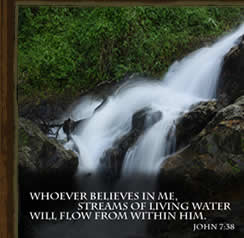 Let’s start a John 7:38-39: “He who believes in Me, as the Scripture said, ‘From his innermost being will flow rivers of living water.’ But this He spoke of the Spirit, whom those who believed in Him were to receive; for the Spirit was not yet given, because Jesus was not yet glorified.” Jesus uses the present participle of pisteuō. In the context, He appears to be referring to the current moment in which he makes the statement … that is, during his earthly ministry. The result of those who believe, in 7:38–39, as John clarifies for us (7:39), is the indwelling of the Holy Spirit. Jesus seems to be saying that anyone who believes him at that moment will become the fulfillment of Old Testament prophecy (“From his innermost being shall flow rivers of living water”). While much discussion on this verse has centered on the OT reference, that isn’t as important for us here. Some of the suggestions are Isa 44:3; 55:1; 58:11; Prov 4:23; Ezek 47:1; Joel 3:18; and Zech 13:1. I prefer Zech 14:15-19.
Regardless, John says that the Holy Spirit was not yet given, because Jesus had yet to be glorified. When Jesus was glorified, the Spirit was given, and then those who believed would become a fulfillment of this. However, during Jesus’ earthly ministry this was impossible. Jesus said himself in John 16:7 that it was not until he left that the Holy Spirit would come. And as Raymond Brown concluded: “it is apparent the gift of the Spirit is Jesus’ way of granting eternal life” (Brown, John, 2:741). So how could eternal life be granted prior to the Holy Spirit being given?
Monday, August 07, 2006
Baptists and Calvinists ... getting along?
May all participants in the upcoming White/Ascol vs. Caner bros. debate continue with the charitable attitude displayed in the last few days. I do look forward to October 16th.
Subscribe to:
Posts (Atom)